

A CHICAGO BEDROOM.
SEVEN GIRLS IN REVOLT.
A SONG MADE OF WEATHER.
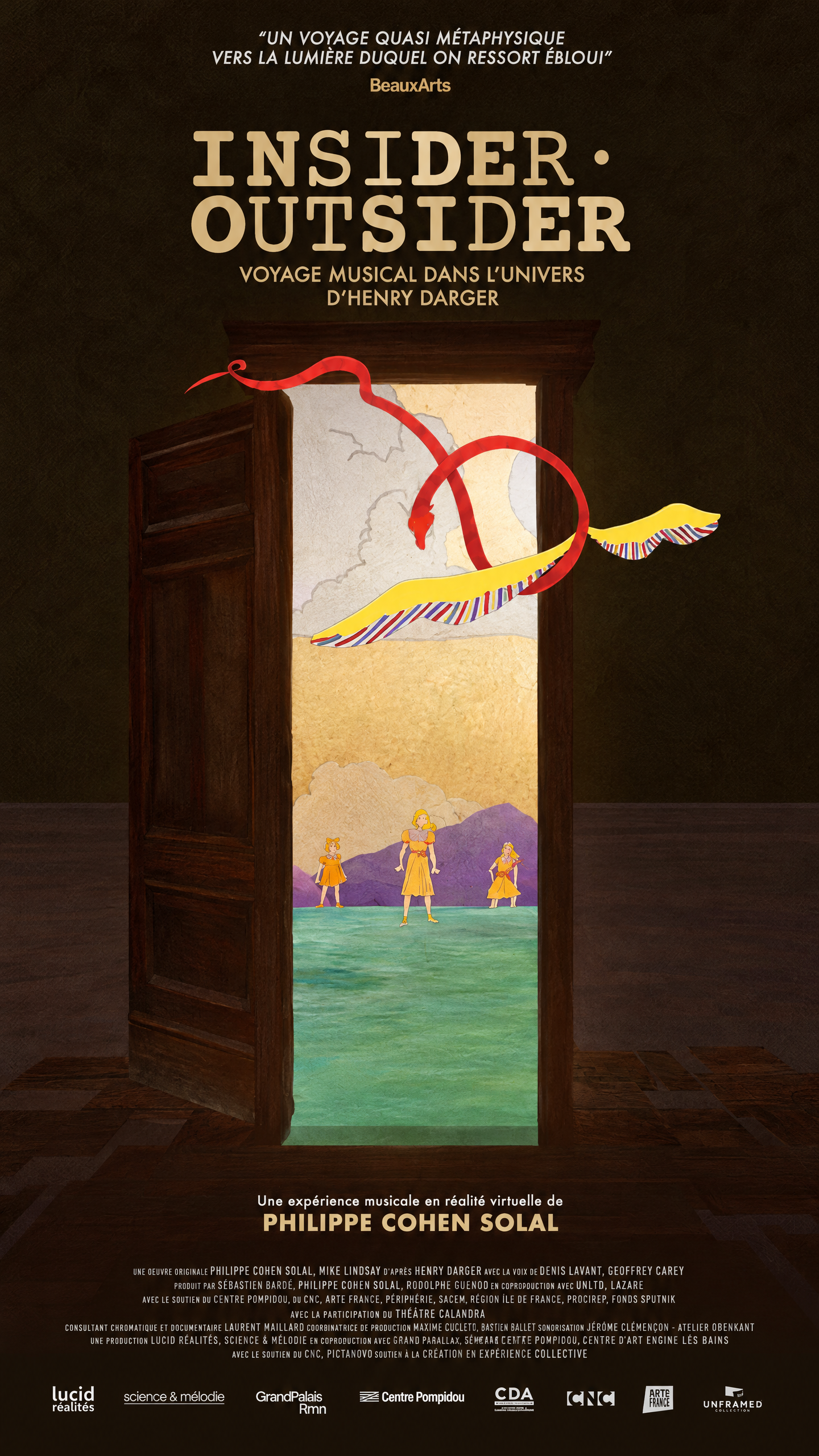
(10)
INSIDER - OUTSIDER
This interview has been edited for length and clarity.
It’s impossible to tell that INSIDER-OUTSIDER is the first VR work by Philippe Cohen Solal.
The interactivity is simple but satisfying for newcomers and veterans alike, thanks to the rich outcomes it offers: control over the sound and landscape of this “unreal” world. It deals with a heavy theme, but through a colourful universe of captivating shapes, the result is uplifting: joyful despite the weight of its themes.
I sit down with Philippe, fresh from trying the experience, and I’m happy to realise that his enthusiasm reflects the joyful spirit of the piece. INSIDER-OUTSIDER takes us into the world of Henry Darger, the reclusive American outsider artist who spent over thirty years creating The Realms of the Unreal alone in his Chicago bedroom. We begin in that room, faithfully reconstructed, and slip into his imaginary world, where seven little girls lead a rebellion against cruel adults.
PHILIPPE IS A SELF-TAUGHT COMPOSER AND CO-FOUNDER OF GOTAN PROJECT. IN 2021 HE RELEASED OUTSIDER, AN ALBUM BUILT ON SONG LYRICS FOUND IN DARGER’S WRITINGS, AND THIS VR EXPERIENCE CLOSES THAT CHAPTER.You mentioned that this was your first time directing a VR experience. What was your first encounter with the medium?
/ PHILIPPE COHEN SOLAL / My first encounter with VR was probably four or five years ago, quite late. The experience I remember most clearly was Le Bal de Paris, by the Spanish choreographer Blanca Li. I really liked it because, when I took off the headset, I looked at the streets and the barriers around me and thought, “I don't want to go back there.” I preferred the unreality.
It's funny, because we talk about virtual reality, but what interests me more is the unreality than reality itself. That's also what I wanted to explore with this project.
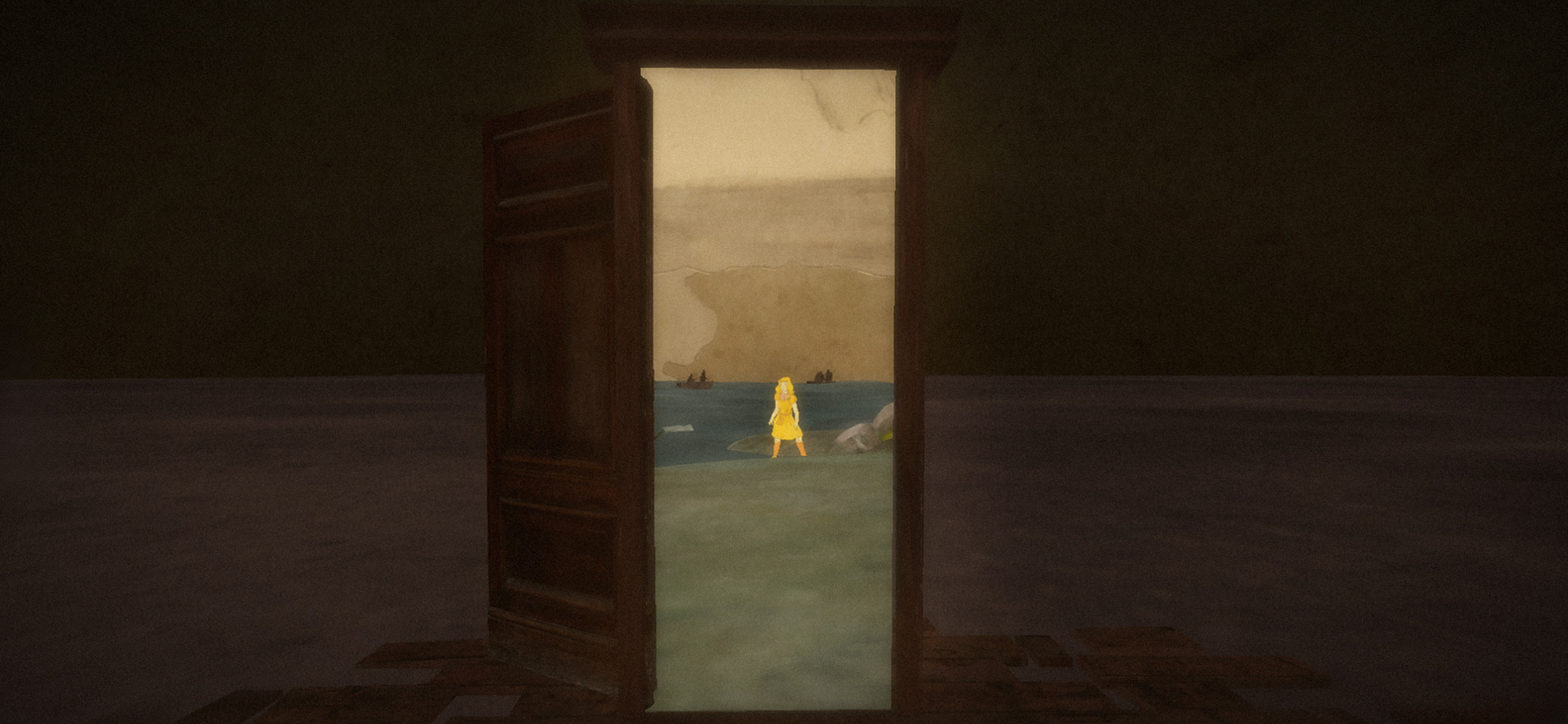
/ One of the Vivian Girls waits on the shore.
How did that idea translate into the world of INSIDER-OUTSIDER?
/PCS/ I wanted to create something based more on the virtual than on reality: an imaginary world inspired by Henry Darger, the American outsider artist.
The first few minutes are very real and carefully documented. You're inside his room, which was reconstructed with the help of Kiyoko Lerner, who owned the room with her late husband Nathan Lerner. They were the people who discovered Darger's work. She could tell me exactly where the bed and table were, how many bulbs were on the chandelier—everything.
Then you move into The Realms of the Unreal, Darger's imaginary universe. That part isn't documented. His two-dimensional images become three-dimensional, and the idea is to immerse the audience in the fantasy world as I imagine it. It's a creation based on another creation: an artist inspired by another artist.
Music is central to the experience. How did you approach its relationship with the visual world and the audience's interaction?
/PCS/ Since I'm a musician, I wanted music to be at the heart of the experience. Sometimes I feel that VR works have great storytelling or visuals, but the sound and music are disappointing. You can sometimes tell that there wasn't enough budget or time for them. I wanted this experience to showcase something very important to me.
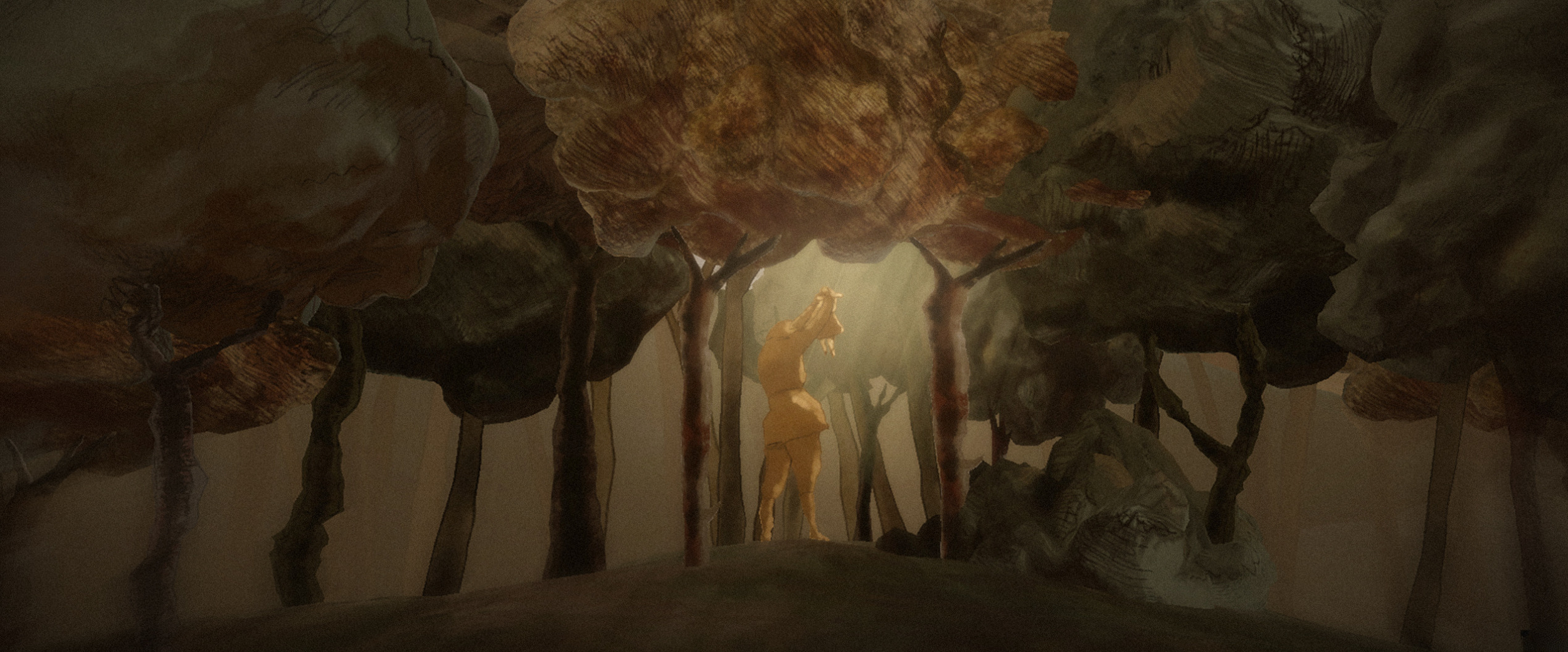
/ Light and danger in the Realms of the Unreal.
Darger was particularly obsessed with the weather. Every day, he wrote down the actual weather and compared it with what the radio or newspapers had forecast. He was so absorbed by it that, even on the day Kennedy was assassinated, he wrote about the weather rather than the death of the president. That's why weather elements are so important in the experience. You can use the wind to help the Vivian Girls escape, for example, or touch elements in certain scenes to spread sunlight around you.
I also wanted the music to be interactive. In Darger's room, you can touch objects such as a book or some balls and bring in different musical stems — drums, bass, guitar, banjo and vocals — until you have reconstructed the whole song. Once you enter the imaginary world, sound and music can also change things around you.
Towards the end, the experience becomes almost psychedelic. You can touch, deform and transform the sound through patterns and elements from Darger's work, using effects such as delay and filters, almost like a DJ. It's less a documentary about the artist than an interpretation of what his work inspired in me. Ultimately, I see it as an interactive music experience.
Coming from music rather than VR, did you find it difficult to communicate your vision and work with a team from a different creative background?
/PCS/ It was frightening at first. When I started talking to Lucid Realities, I assumed I would be the musician. I already had the story and the music, and I knew what I wanted to do. But they told me I should direct the project because I had a clear vision.
I didn't feel capable, since I had no experience in VR. But you have to start somewhere, and you build experience by doing. I was fortunate to have an excellent team around me. The sound designer was fantastic, the developers were great, and everyone was very collaborative and understanding. I could ask, “Can we do this?” and they would tell me whether it was possible or too complicated. We had a very good working relationship.
We additionally made a five-minute prototype, which gave me time to reflect on what I wanted the experience to become. For the final sequence, for instance, I wanted to create something that felt almost like an acid trip. I was interested in the sensation of being surrounded by elements — the wind, the environment — and being able to touch and transform them. I wanted to translate that feeling into the experience without using drugs, of course.
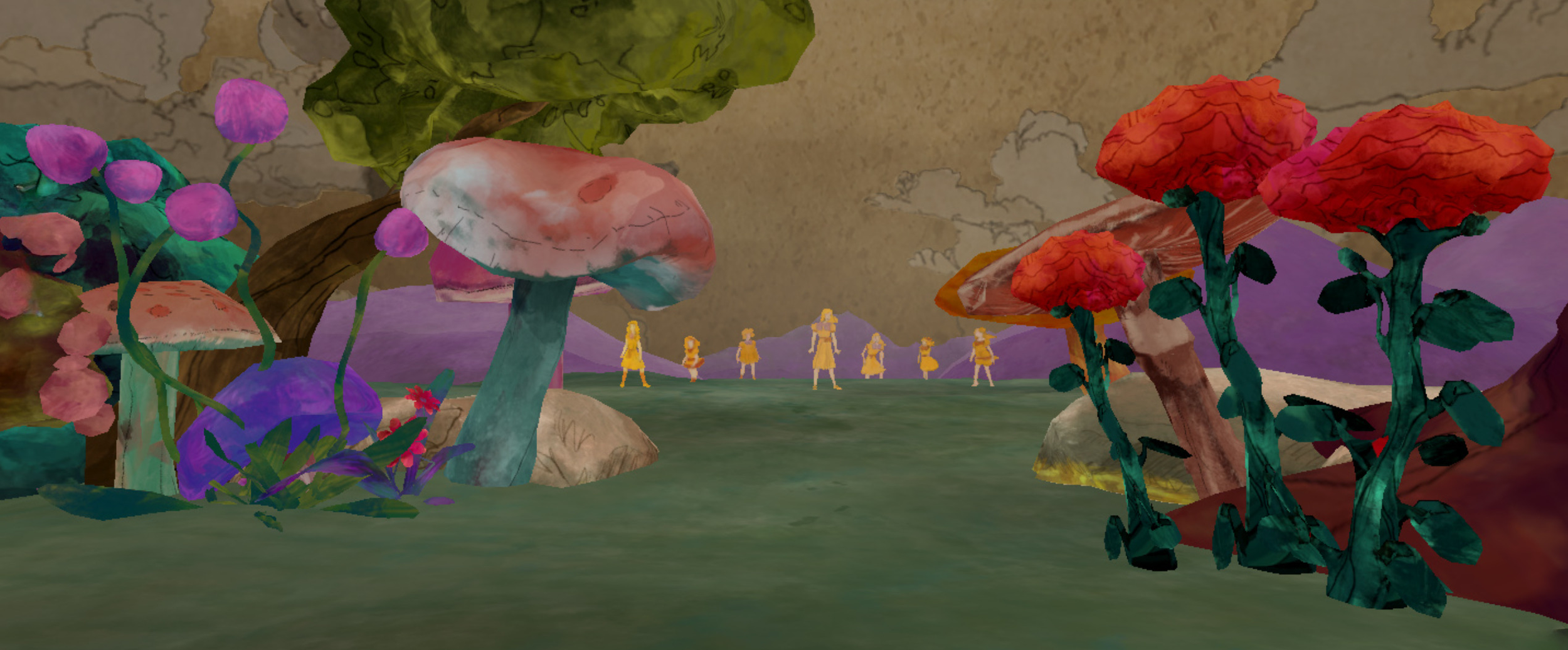
/ Giant mushrooms: the lighter side of Darger’s world.
I also wanted to remain faithful to Henry Darger's work while being, in a way, a little disrespectful towards it. If I had followed his work too literally, I don't think the result would have been as interesting. To create something new, you need love, but also a certain freedom from your subject. Otherwise, you don't bring your own voice into it.
It took you some time to find the right production partner. How did that process unfold?
/PCS/ It took me three years to find the right team, particularly the right company. I spoke to many people in the VR field. Some were interested, but most wanted me to tell them exactly what to do and then pay them for the work. I was looking for a co-producer. I already had the music, the storytelling, the connection with the copyright holder, and the two-dimensional animation created with Gabriel Jacquel, who had worked on the images and animation for the music videos, as well as some mapping projects. I was bringing quite a lot to the table.
“It took me three years to find the right team.”
After three years, I happened to speak with Claude Farge, who is the head of Forum des Images in Paris and also hosts the NewImages Festival. He suggested I meet two companies. I presented the project to both, and they loved it.
In the end, I chose Lucid Realities partly because they knew Henry Darger's work well, but also because they had strong distribution connections. I was worried that, once finished, the experience might simply stay in a box. I really wanted it to travel.
Something else happened thanks to the prototype. It was shown at an art centre in Enghien-les-Bains, during a festival called Les Bains Numériques, where people from the Centre Pompidou and the Grand Palais saw it and became interested. The project was subsequently presented at the Grand Palais as part of an Art Brut exhibition, for three months, with eighteen headsets. Going from having no one interested to working with such strong partners was a dream. It reminds you that you should never give up.
How did you balance your own artistic vision with the need to make the experience work for an audience?
/PCS/ The experience of the Lucid Realities team and the feedback from people at the Centre Pompidou and the Grand Palais helped a lot. They came regularly to see how the project was developing and tell us what worked and what didn't.
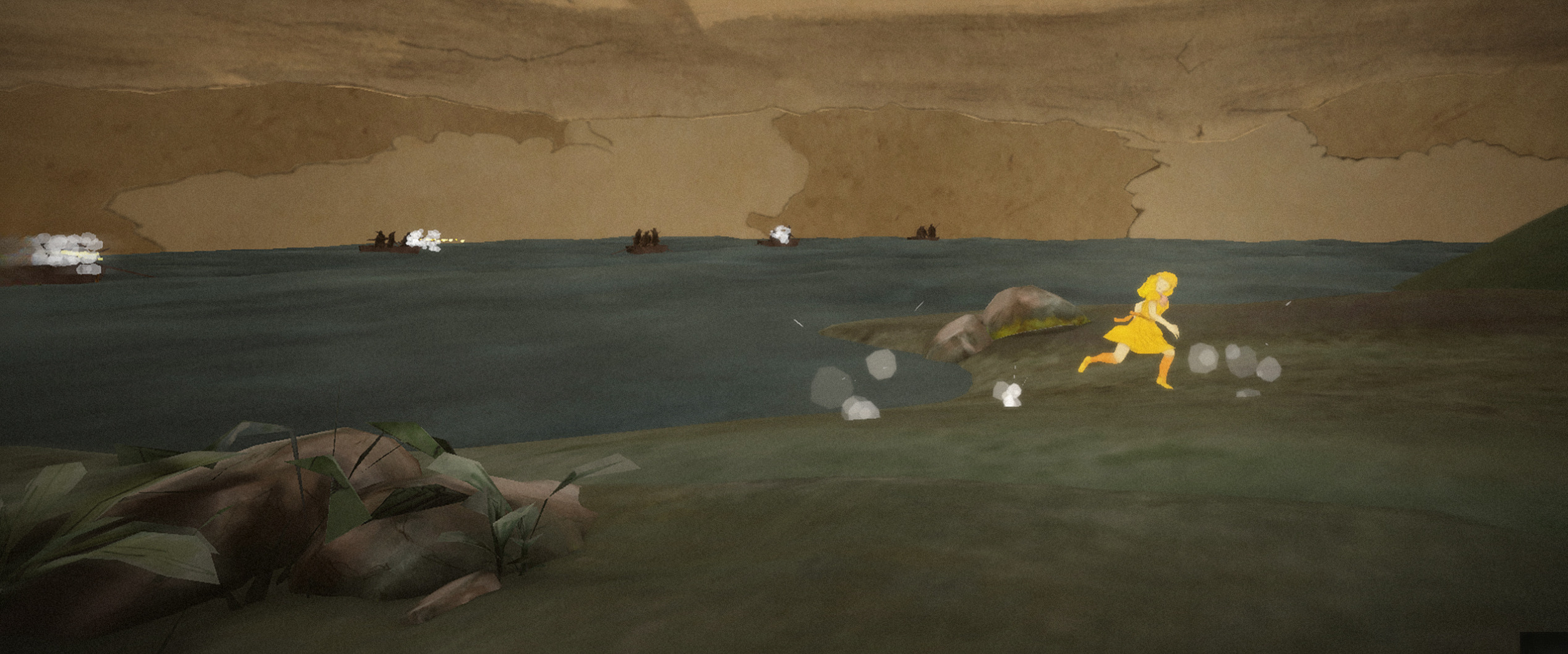
/ At the water’s edge, where the weather shapes the world.
You have to maintain your own vision while remaining open to other people's comments. In this case, the feedback was always interesting. It's the same challenge you face in music: you have to make something for yourself, but also be generous towards the audience. You can't make something exclusively for them, though, or you lose yourself.
“The hardest thing is to transmit emotion. You can't manufacture it. You have to bring your own feelings into the work.”
I discovered Henry Darger's work in 2003. We've been talking about more than twenty years of trying to understand and immerse myself in his universe. In a way, this VR experience is the final step in that relationship. It feels like a collaboration, although Darger died in 1973 and, of course, knows nothing about it.
One of the best compliments I received came from the director of the Musée d'Art Moderne de Paris, who told me I hadn't betrayed Darger. That meant a lot to me. I had done my own thing, but I hadn't betrayed him.
How did you decide how much interaction to include?
/PCS/ I'm not really into gaming. I've never been particularly interested in experiences where you have to win something. I'm more drawn to the poetic side of VR, and the experiences I like most are often the most poetic ones.
I wanted the interaction to be connected to music and sound rather than to actions and reactions. There are things you can do, but I didn't want the experience to feel too invasive or demanding. It's a bit like walking down a street: you don't need to be doing something all the time. If you're in a forest, you don't need to look at your phone at the same time. You just want to be there and experience it.
There's already enough hyperactivity in the world. We don't need to bring more of it into virtual reality. I wanted the experience to have a meditative quality.
I also set out to work for different generations, including people trying VR for the first time. They often don't interact very much because they're simply amazed by being there. And that's fine. If someone just wants to watch the sky and the clouds, that's enough. You can enjoy the experience without interacting at all.
You intended the work to reach audiences beyond the VR community. How have you approached distribution?
/PCS/ I never wanted the experience to end up in a drawer. That's something I think about with my music as well. I'm French and based in Paris, but I've always thought internationally. I would imagine what friends in London or Los Angeles might think of my music, rather than focusing first on the French audience and hoping international interest would follow.
I approached VR in the same way. I wanted the work to travel to museums and cultural institutions, but also to music festivals. I was eager to hear responses from people across different cultures and nationalities. That's why Unframed Collection, the distribution company, felt like the right choice. They've done a great job. The project has won the Villa Albertine Immersive Storytelling Prize in Miami and La Scam's Prix Nouvelles Écritures in France. This September, it was also shown at the Gwangju Biennale in South Korea.
“I was eager to hear responses from people across different cultures and nationalities.”
/Philippe Cohen Solal
A lot of immersive work seems to gravitate towards dark subjects and atmospheres. Do you think that's a reflection of the medium or of the world we live in?
/PCS/ I agree that there's a lot of dark VR. Sometimes I feel it's easier to make something dark than something light. I've seen work at South by Southwest and elsewhere that felt almost depressive. Of course, it's interesting to explore dark territory, but the world is already dark enough. I think we should try to bring light whenever we can.
That's also true of Henry Darger's work. Some parts are very dark, violent and controversial, but I wanted to foreground its lighter side. Now that I know his work so well, I realise that the darker, more violent elements represent perhaps only twenty per cent of it. The rest is much lighter. He was trying to create a world better than the one he lived in.
/ The Vivian Girls at the centre of Darger’s imaginary world.
He had a terrible childhood and a very difficult life. He worked as a hospital janitor and had no friends. Through his imagination, he created a world in which children were the strongest and bravest, and little girls were the bravest of all. He wrote that women were braver than men in times of war, which is why the heroines of his story are seven little girls leading a rebellion against slavery and cruel adults.
I wanted to preserve that lightness in the experience. There are dark moments, of course, but the journey ultimately moves towards something brighter.
I recently saw Lesbian Simulator, and I loved it. It's joyful and colourful, while still addressing real experiences and the way people react to lesbians. It manages to approach something that can be difficult or painful without becoming depressing. I'm much more interested in light than darkness, even though I can appreciate dark music too. More and more, I'm trying to bring hope into my work.
What advice would you give to artists coming from music or the visual arts who want to experiment with VR but feel intimidated by the technical side?
/PCS/ Dare to try. If you have an idea, a vision or a story to tell, that's what matters. VR is ultimately about telling stories and bringing emotions to people. Technique is never the most important thing. It's a tool.
I'm self-taught as a musician. I never went to a conservatory, so I've always had to compensate for my lack of technical knowledge with creativity. If you're not a great technician, you have to be a fiercely great creator. I've seen people get stuck in a vicious circle of technical concerns. What matters is what remains afterwards — what stays in your mind and the emotion you take away from a film, an album or an experience.
/ Giant flowers: the lighter side of Darger’s world.
Try things you haven't experienced before. Don't copy. You can be inspired by other work, and even an experience you dislike can be useful because it shows you what you don't want to do. It's also important to find the right partners: production companies and collaborators who respect your work.
That was particularly important for this project. A lot of VR experiences have a futuristic aesthetic, whereas INSIDER-OUTSIDER is almost the opposite. The two-dimensional imagery is rough, raw and imperfect. It has a vintage, old-world feeling, something closer to the past than to the future. I wanted to preserve that.
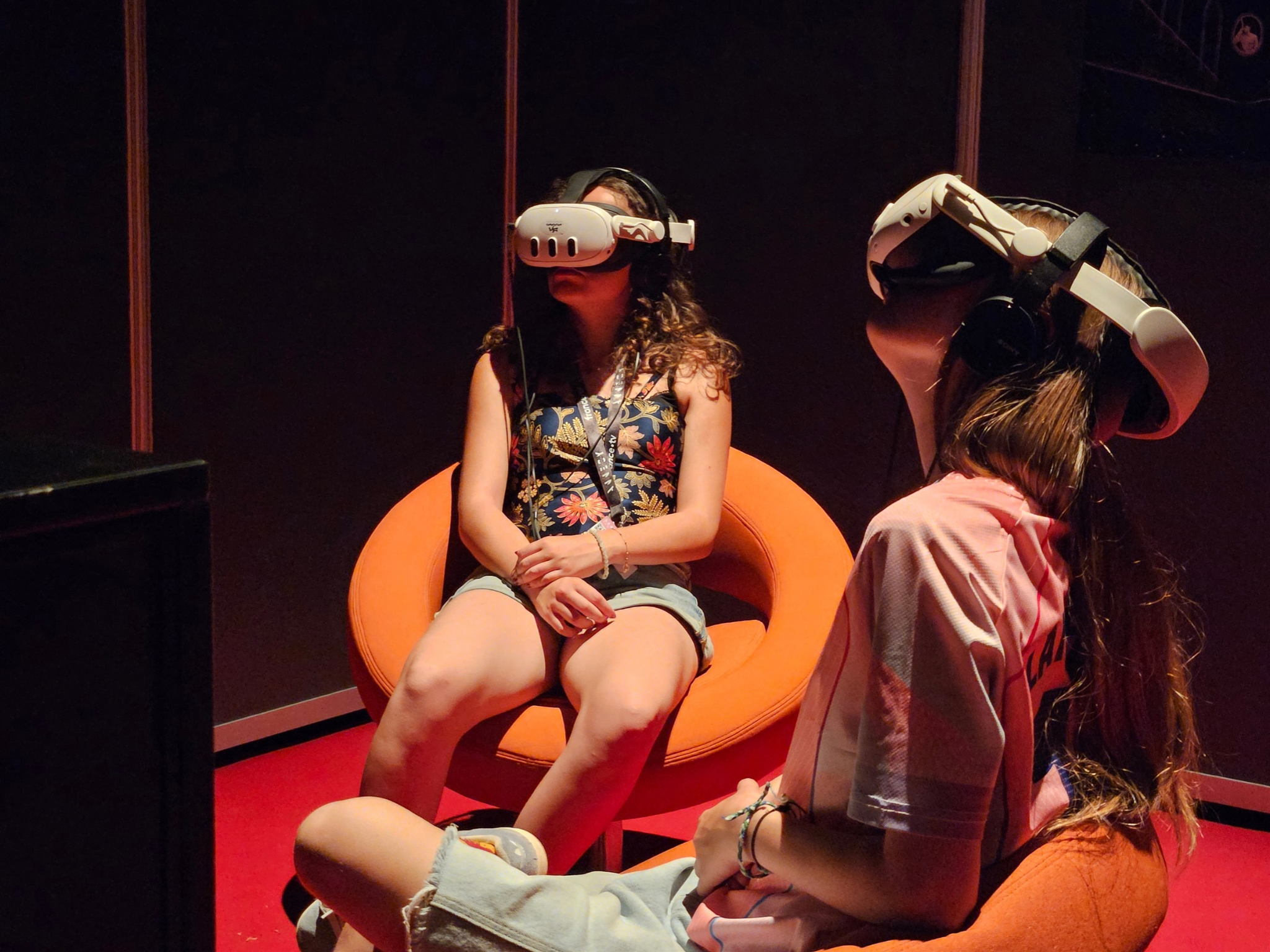
/ INSIDER-OUTSIDER at the Salle de création, Bonlieu, during the Annecy Festival.
Are there any immersive works that have stayed with you or changed how you think about the medium?
/PCS/ There's a Japanese work, Yorutouge (Kikuo, mikkabouzu, VR_SMEJ). It was very colourful, a little like Lesbian Simulator in its visual style: you're inside something resembling a techno rave, surrounded by characters that don't really exist. I loved it.
I also saw a Korean VR experience about the Korean War at South by Southwest 2026, The Forgotten War (Hayoun Kwon, Innerspace VR). It was very thoughtful and historically accurate. But my strongest memories are usually of works closer to fantasy: joyful, feel-good experiences. Those are the ones that stay with me most.

Philippe came to VR from music, and he says it plainly: technique is a tool, and what stays with you is the emotion. INSIDER-OUTSIDER closes twenty years of living with Henry Darger’s work and, true to its maker, chooses light over darkness. In a world he finds dark enough already, it is a reminder of what immersive work can offer: a way into joy, not away from reality, but towards something that makes us want to hold on to it.
/ INSIDER-OUTSIDER. Philippe Cohen Solal, France, 2025. VR: 12 min.