

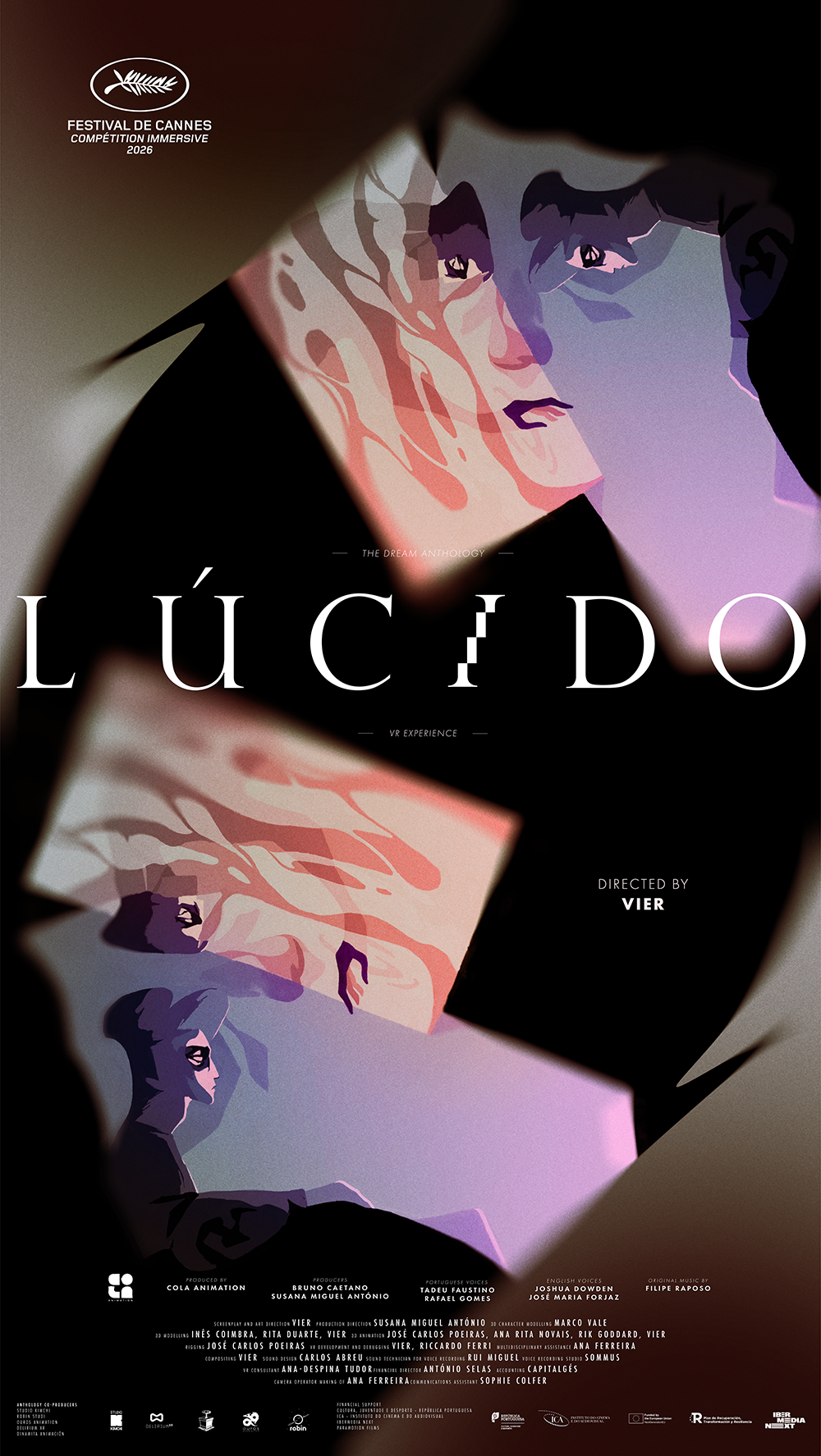
(09)
LÚCIDO
DREAM STATES.
CHOSEN FAMILY.
RELUCTANT GOODBYE.
This interview has been edited for length and clarity. The conversations with Vier and Bruno Caetano, and with Susana Miguel António, took place separately and have been combined to give a fuller picture of Lúcido.
What a joy to see one of the best experiences at the Annecy Festival come from my own country. Lúcido is the first Portuguese immersive work to be selected for the festival. It showcases an elegant command of XR grammar: thoughtful use of space, just the right amount of interaction, and a wistful story that, despite the unease of the events around it, leaves you with a bittersweet feeling as you take off the headset.
Lúcido follows Gil, who learns to control his dreams with the help of his boyfriend, in a story about lucidity, escapism, loss, and chosen family.
Vier is a Portuguese multidisciplinary artist who plays with light and shadow to create images that can be read in more than one way. He wrote and directed Lúcido, produced at COLA Animation by Bruno Caetano and Susana António. Bruno is a stop-motion animator, producer, and founding member of the cooperative, which is also behind Ice Merchants, nominated for an Oscar in 2023. Susana, a writer and director, has produced animation for ten years and recently founded her own studio, Anã Azul.
Speaking with the team was a personal quest. As a Portuguese producer myself, I needed to hear first-hand how the producers moved from their usual formats to an immersive work. I also wanted to understand why a Portuguese artist like Vier chose to tell his story in VR, as part of my ongoing effort to open the medium to artists from different creative fields.
A STORY ABOUT LUCIDITY, ESCAPISM, LOSS, AND CHOSEN FAMILY.
How did you first encounter virtual reality?
/ VIER / I studied multimedia, and one of the projects proposed during my degree involved creating a virtual reality experience. That was my first contact with the technology. I decided to make my final project in VR, and a teacher lent me his HTC Vive, which at the time required tripods and external sensors to work. It was an academic introduction, though I didn’t have much time to explore other experiences. I only began developing a broader understanding of VR as a medium when I bought a headset during the pandemic.
/ BRUNO CAETANO / My first encounters were in arcade spaces in the 1990s and 2000s, with collaborative games where everyone wore a headset. I remember being disappointed. The graphics weren’t very good, and the tracking wasn’t quite there yet. It didn’t feel immersive in the way we understand the term today.
It was only when I bought a Quest 2 during the pandemic that I began to understand the technology’s potential beyond gaming. I discovered that you could tell stories and make documentaries in VR, and that these could be incredibly immersive experiences. Vier also played an important part in that shift. Lúcido had been an idea for years, and as we started discussing what we wanted to do with it, I became more curious about the medium.
/ SUSANA MIGUEL ANTÓNIO / My first contact with VR came through Lúcido. I started at COLA Animation around 2022, working with Vier on the 2D short Dança dos Fanchonos, but in 2023 a new funding opportunity came up: Ibermedia Next, a programme tied to the EU’s post-pandemic recovery. Since the deadline was very tight, we paused the short to make the VR experience instead. I learned a huge amount, especially from Vier, who had been working in VR for a long time.
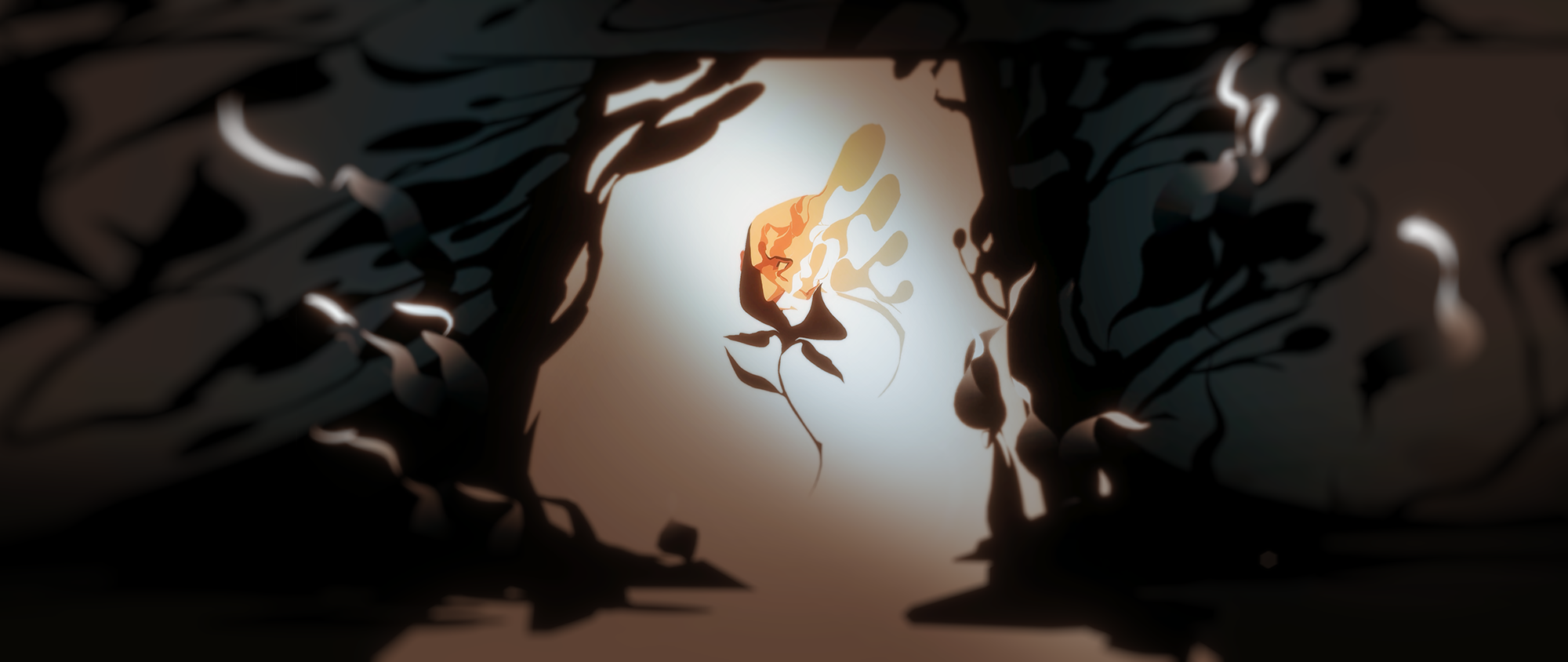
/ Double image portraying both a flower and one of the protagonists.
Was there a particular experience that made you realise what VR could offer creatively?
/V/ Experimenting with tools such as Tilt Brush was important. I began to understand the creative potential of having an infinite canvas: the possibility of creating entire worlds and placing people inside them. In a way, it reminded me of animation. There’s a similar desire to control everything within a frame — to sculpt or draw every element. But in VR, that frame extends to the entire space surrounding the audience.
Experiences such as Dear Angelica (Saschka Unseld, Oculus Story Studio) and Tea for God (Jarek Ciupiński, Void Room) also made an impression on me. The latter plays with perspective and uses hidden portals to create the illusion of an endless corridor. That was particularly interesting to me because my visual work already explores perception and the way realities can overlap.
/BC/ I remember discovering Tales from Soda Island (Simone Fougnier & Dan Franke, Studio Syro), which starts with a simple animated experience and gradually takes you into different worlds. Then I explored more narrative experiences and games. As a Star Wars fan, Vader Immortal (Ben Snow, ILMxLAB) was particularly exciting: suddenly, you were inside a universe you had known for years.
But experiencing other people’s work is different from being part of a team creating a world from scratch. After spending so much time discussing Vier’s ideas, it was extraordinary to finally enter the world he had imagined.
How did you communicate your vision to people who had never experienced VR, particularly collaborators coming from traditional animation?
/V/ I created a prototype showing the main interactions and perspective effects. I also made a video of someone experiencing Lúcido. A video obviously can’t communicate the scale or the feeling of presence, but it can show the first-person perspective, how the audience moves through the space and some of the visual interactions.
Throughout production, the videos, playthroughs and animatic were important tools for communicating what I had in mind, both to the team and to the people involved in the project.
/BC/ I remember trying the prototype at Vier’s house. It already gave me a sense of immersion, but as the project developed, I realised how much it was only a sketch of what the final experience would become. The work evolved considerably, both visually and narratively.
But there are similarities with producing an animated short: you need time, experimentation, discovery and constant exchange between people. The main difference is the additional programming and problem-solving involved.
I also think it’s easier to explain VR to people who come from animation because they already have a visual language. Ultimately, though, there’s no substitute for putting on a headset. You can explain it as much as you like; when people enter the world themselves, something clicks.
Vier, how did you develop the universe of Lúcido?
/V/ Many of my projects begin with images. In this case, I had an illustration of a character sitting on a sofa, watching television, while another character crossed a portal. When I turned the image around, the expression of the person sitting on the sofa changed. I was interested in that double reading: the same image could suggest different emotional states.
It made me think about a character being haunted by another presence. At the same time, lucid dreaming had been part of my life since adolescence, and I had wanted to explore it narratively for some time. I started thinking about what it means to be lucid in a dream: when do we want control over our surroundings, and why? Why do we sometimes prefer not to know that we’re dreaming?
Those questions led me towards mourning and the way dreams can bring back happy memories. Sometimes we want to remain inside those memories rather than accept that they aren’t real. That became the emotional basis of Lúcido.
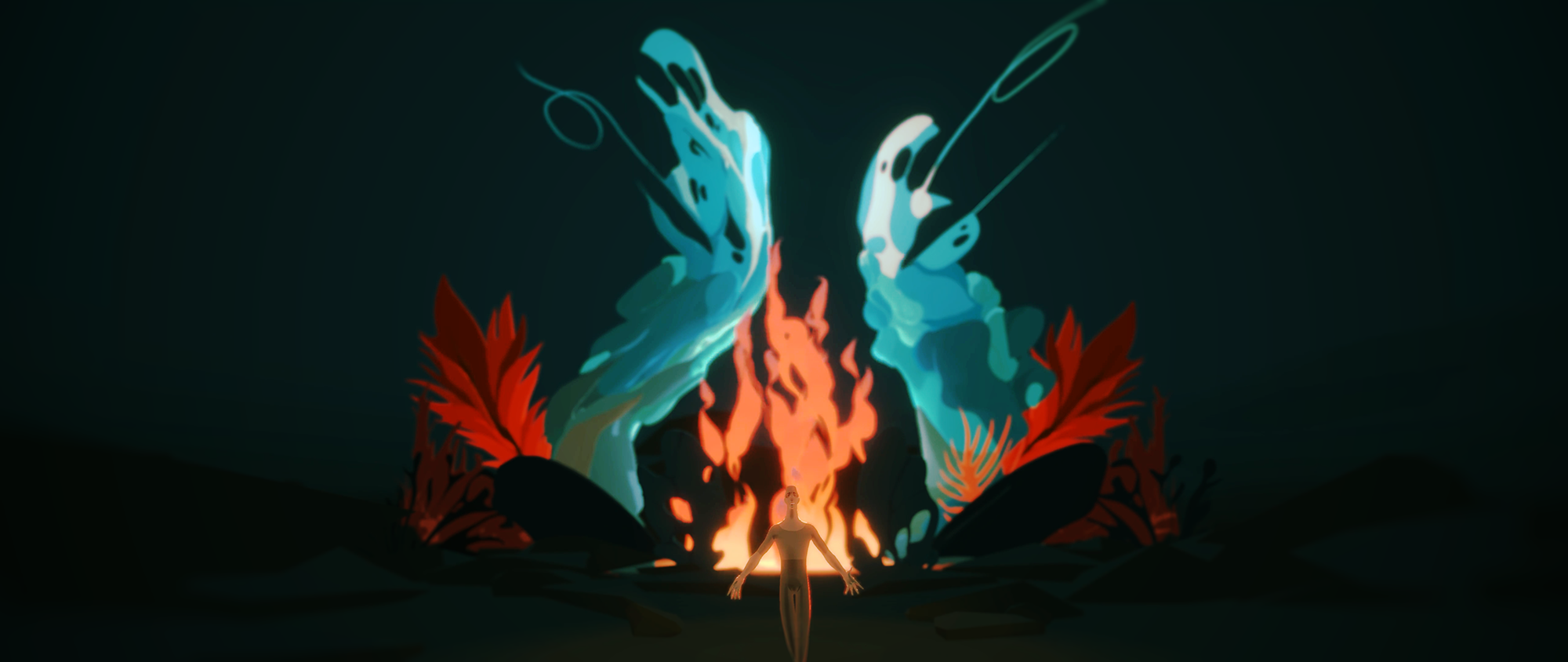
/ Gil enters a lucid dream.
Was it difficult to balance that initial idea with the need to create an experience that would work for an audience?
/V/ There was a process of simplification. I wanted to make a finished, professional work, with good animation, a cohesive structure and an intelligible narrative. During my master’s degree, I had developed many different interactions, particularly using hand tracking to change the virtual environment. For Lúcido, I selected only two or three that best communicated what I wanted to explore.
The initial prototype included many more of them. It was very experimental, but the interactions started to distract from the story. I had to learn how to manage the audience’s attention and only offer the possibility of doing something when it was relevant to the narrative. Simplifying is part of bringing it to life.
“Eventually, you gain control over the world itself.”
The relationship between the audience and the protagonist seems particularly important. How did you approach interaction as a way of guiding the experience?
/V/ One of the biggest challenges was finding a way to communicate the protagonist’s different states of lucidity. I used embodiment — the relationship between the audience’s body and the character’s body — as a way of expressing that. When you have control over the character, he’s still lucid. When he separates from you, and you see him from a third-person perspective, he is inside the dream and doesn’t know he’s dreaming.
The interactions also develop in stages. You begin with a simple interaction with an object, then gain control over your body, and eventually over the world itself. This progression reflects the increasing sense of power within a lucid dream.
Guiding the audience’s attention was another important part of the process. The first scene works almost as a landing zone: the environment is relatively still, and the character gradually introduces you to the world.
Light, movement, and sound all help direct your attention. As the experience progresses, the world becomes more chaotic, but the character also acts as a guide, helping you feel that you’re not completely lost.
Susana, what did producing Lúcido teach you about working in VR, particularly coming from animation?
/SA/ It was my first experience producing a VR project, and following its development from beginning to end was an eye-opener. I had previously produced The Hunt, a 3D animated short by Diogo Costa, and that experience was very useful. We already knew many of the collaborators and understood what a 3D animation pipeline involved, which made it easier to build the team for Lúcido.
The biggest difference from a traditional animation production is the programming. You still have the concept, the script, character creation, modelling, rigging and animation. But the script has additional questions to address, particularly around interactivity and how much control you want to give the audience. Post-production also involves a substantial amount of debugging.
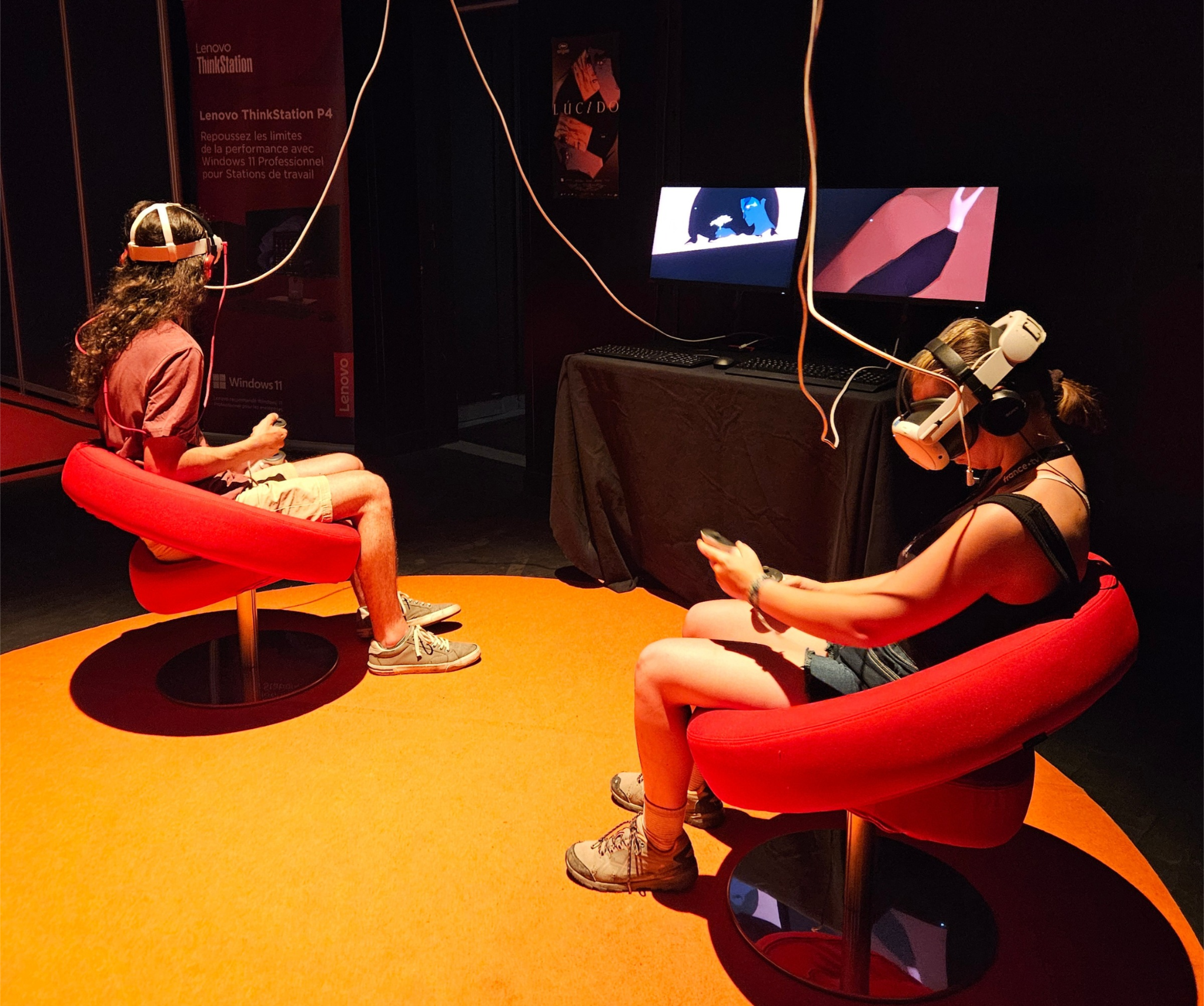
/ Lúcido at the Salle de création, Bonlieu, during the Annecy Festival.
The knowledge of animation production is very transferable. Our music and sound collaborators, Filipe Raposo and Carlos Abreu, had never worked on a VR project before, but their experience in cinema and animation was extremely valuable. There was also a sense of discovery in working with a new medium. People who are experiencing it for the first time can bring a particular energy and curiosity to the process.
As producers at COLA Animation, Bruno and I were very lucky to work with Vier on a project like this. Vier knows exactly what he wants and how to use the tools in his favour. But it was also a huge learning experience for him: the first time he led a project from start to finish.
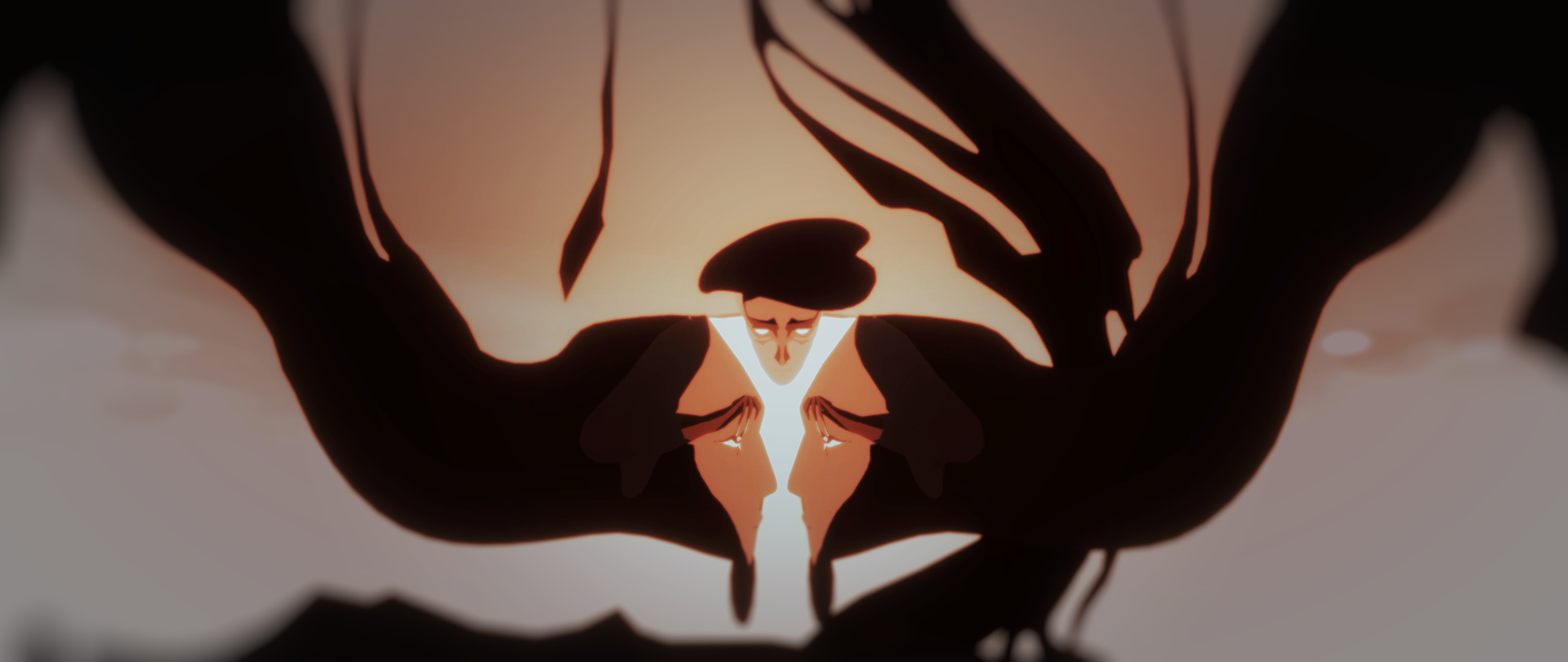
/ Nightmare scene.
How did you describe Lúcido to people outside the field, who don’t yet have a shared language for VR?
/SA/ I’d say it’s essentially a short film, but with a quality of immersion and interactivity that lets you feel you have control over the narrative, even if you don’t truly have it. In Lúcido, the story isn’t altered by the audience’s actions, but you genuinely feel you’re having an impact on it.
I also try to explain it like this: it’s as if you were looking at a painting in a museum and could step inside it. Suddenly you can see the sheep, the meadow, and it’s almost so real you can smell the grass. What people can’t grasp until they experience it is the scale, that feeling of smallness. Even with objects and characters as stylised as Vier’s, everything feels almost within reach.
There’s also something I recognise from theatre, where I worked before film: the challenge to the audience’s attention. When several things happen at once, you have to decide where to look. If you’re looking backwards, you won’t see what’s happening in front of you. The first time I experienced Lúcido, I had to remind myself that I wasn’t meant to sit still in the chair. You still carry that cinema-spectator habit of watching from one place, and VR is exactly the opposite: you have to explore.
What were the main challenges in bringing the project to production?
/BC/ The funding situation was difficult. At the time, the Innovation in Multimedia programme run by the ICA (Portugal’s Institute for Cinema and Audiovisual) was the only national programme where projects like this could find support. It has since ended, and we were among the last projects to receive funding through it. We received support for development, but production was a different matter. The team made considerable sacrifices to bring the work to the level we wanted.
I think this is an important moment to create opportunities for people to experiment. If you remove support at the development stage, you also remove the possibility for creators to discover what the medium can do.
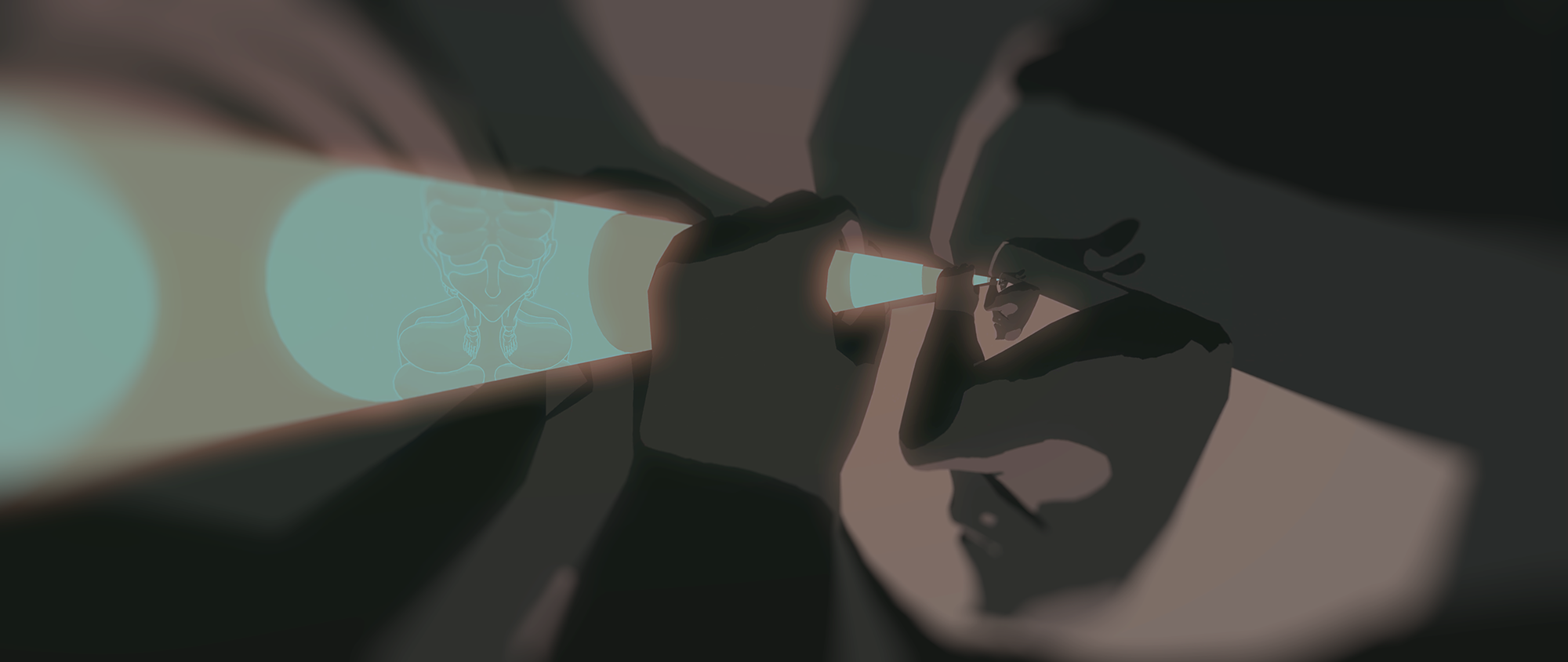
/ Fractal imagery,
/SA/ Funding was crucial. We first received support through the ICA’s programme, and later through Ibermedia Next. The latter was particularly important because it supported not only development but also training and access to consultants.
Lúcido was, in a way, the pilot for a larger project, The Dream Anthology, developed with other studios through Ibermedia Next. Each studio made its episode independently, with its own visual style. I coordinated funding and communication between the studios, and Vier acted as technical coordinator. We brought in Dr Ana-Despina Tudor, who had taught Vier at the London College of Communication, to give masterclasses on storyboarding and immersive storytelling. This was especially useful for studios that had never worked in VR.
Not everything fitted, though. Many of the training opportunities weren’t suited to VR. Distribution was our main goal going in, and we couldn’t find anyone who could really support us on that front.
For Lúcido, one of the most important technical challenges was debugging. Vier does a lot of programming himself, but we also had support from Ricardo Ferri, an Italian programmer then collaborating with our co-producers, Robin Studio, in Turin. That extra support was essential in getting the experience to work as intended.
And once a project is made, how do you find a route to its audience? Is distribution very different from what you know in animation?
/SA/ Completely. In animation, after ten years of producing, I have a much clearer idea of who the distributors are and which partners might be right for a particular project. With VR, we were entering a field we didn’t know.
We started asking other creators about their experiences and the distributors they were working with. I would attend pitch sessions at festivals and use meetings to ask people who they knew in VR distribution. Those conversations gave us some direction. The Curators Network at Cannes was particularly useful because it brought us into contact with curators, festivals and people working in sales and distribution.
At the time we spoke, we were still looking for the right partner. It’s a process of taking things step by step, trying to understand what each distributor can offer and whether they’re the right fit for the work.
“With VR, we were entering a field we didn’t know.”
/BC/ It’s a very small community, but also a close one. We contacted some distributors before the project premiered, but received very few replies. Once we had launched Lúcido at Cannes and announced our presence at Annecy, the response became more open.
You need people who already have the contacts, understand the different routes and know how to position the work. We need that experience, particularly while Vier is also finishing another short film.
/V/ We initially thought about distribution in three phases: first, the festival circuit, to build visibility and create a conversation around the experience; then cultural spaces, galleries, museums and institutions with the technical capacity to exhibit it; and finally, online distribution.
Looking at the work you’ve experienced recently, do you feel VR is moving towards more personal and author-driven storytelling?
/BC/ For a long time, many of the experiences I encountered were focused on entertainment — on making people have a good time. As the technology becomes more accessible, younger creators are finding ways to use it to tell their own stories. I think we’re going to see more personal work, just as we do in animated short films.
Lúcido is a good example because it’s a story that comes from Vier’s own experience. We both talked about lucid dreaming when we first discussed the project. There’s a saying that if you’re going to tell a story, you should tell one you know well. I think that personal connection comes through in the work.
/SA/ I believe there’s a shift from VR being used from a video-game perspective towards a more artistic, author-driven experience, and when you move that way, you inevitably end up addressing serious subjects. I also think the political situation in the world influences what artists want to explore: when things feel like they’re slipping out of our control, we turn to art to understand what’s happening. At the same time, there can be a desire for humour and lighter work, as a way of finding relief.
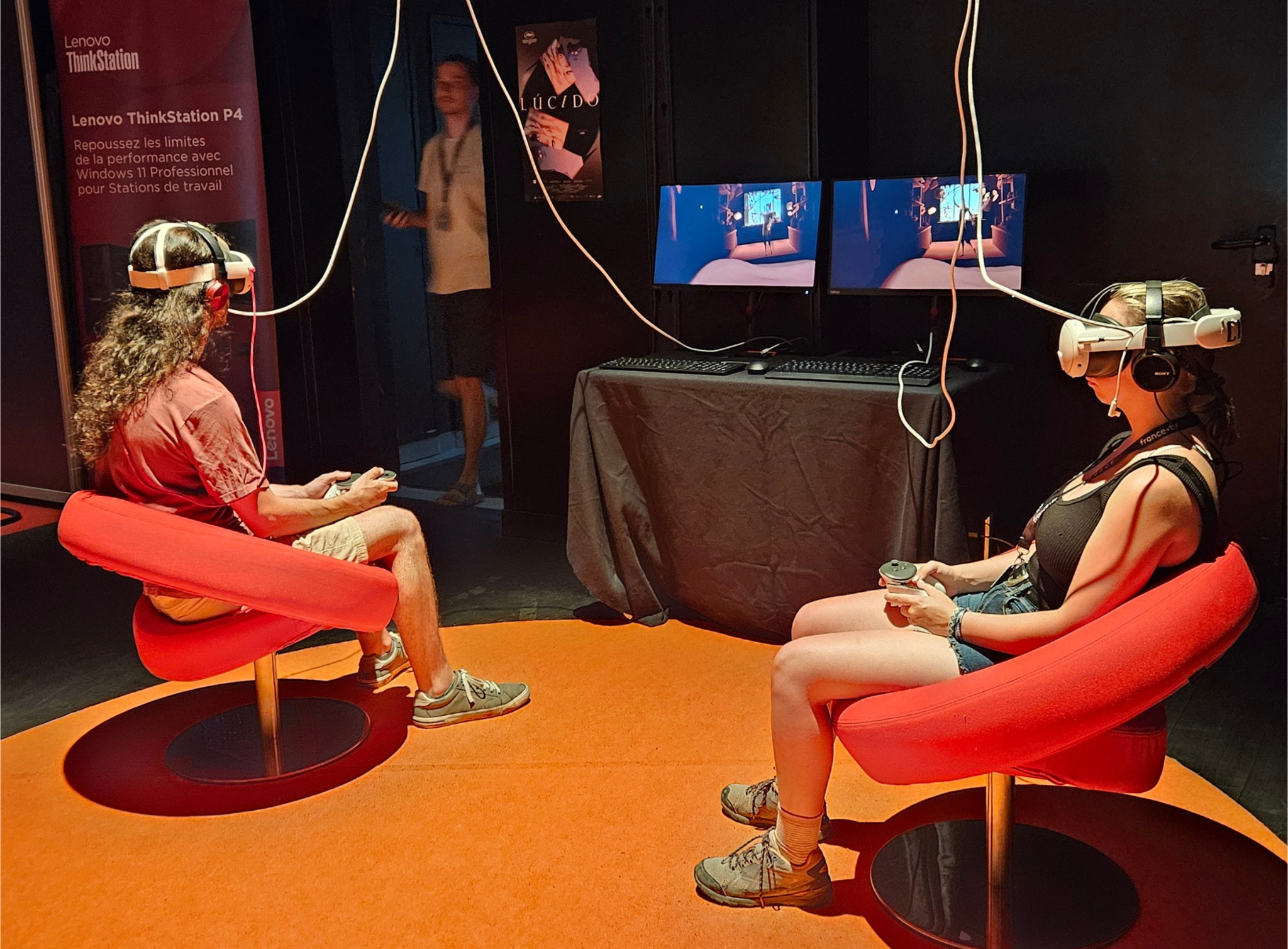
/ Lúcido at the Salle de création, Bonlieu, during the Annecy Festival.
What interests me about Lúcido is that, although it deals with loss, it also has a sense of beauty, and it brings the audience into contact with a reality that’s very specific to queer existence. Loss is universal, but the idea of chosen family is something many people don’t know. In a way, the experience is an attempt to escape a nightmare. I think that’s something many of us are trying to do right now, not by pretending nothing is happening, but by trying to understand it.
Where do you see VR going, and how can it reach wider audiences?
/SA/ I think access is one of the biggest questions. Headsets are expensive, become outdated quickly and remain out of reach for many people. That’s why I believe festivals, museums and cultural spaces are important ways of bringing VR to wider audiences. At Cannes, we had a hundred people doing Lúcido simultaneously, which is something big. But even so, a hundred people is nothing compared to a cinema screen. VR may never replicate the collective experience of cinema, but it can create other kinds of encounters with an audience.
/BC/ For me, one of the most exciting things about VR is the possibility of placing someone inside a world that an artist has created. I think the technology will continue to change, and the headsets will become lighter and more accessible.
What was it like to see audiences experience Lúcido for the first time?
/BC/ I loved what we did, but there’s always a different validation when you release a work to the world. In Cannes, with a room full of people wearing headsets at the same time, all of them reaching out into the air, some were completely dazzled by the experience. The feedback also helped us file down small things so it would work for the majority of users. It was an experience I’ll never forget.
Vier, as a viewer yourself, what would make you want to spend more time in VR?
/V/ At the moment, I rarely use it because I associate VR with the thousands of times I had to put on the headset to test the loop while working. The moments when I explored most were when I didn’t have that pressure, and VR was something extra.
“Its greatest potential lies in bringing it into our social activities.”
/ VIER
For me to bring it into my routine, it would have to be more social. Most VR experiences are still quite lonely, which is legitimate, as are most games, but including it in our social activities is, I think, its greatest potential to become culturally relevant. I also don’t feel there are many cultural events that include VR in Portugal at the moment, and the entertainment spaces that do offer it don’t have a strong cultural component.
Since its world premiere in Cannes’ Immersive Competition, Lúcido has screened at more than a dozen festivals, from Annecy and Geneva to Thessaloniki, Kaohsiung and São Paulo. It won the Immersive Award at the Imagine Fantastic Film Festival 2026 and is nominated for the 2026 European XR Awards.

The warm reception the piece has received from audiences and cultural institutions alike shows just how much potential Portuguese artists have in XR. But to flourish, they need access to immersive experiences, training, and funding. Investment in narrative XR in Portugal has to grow accordingly. Lúcido proves the talent is already here.
/ Lúcido. Vier, Portugal, 2026. VR: 17 min.