

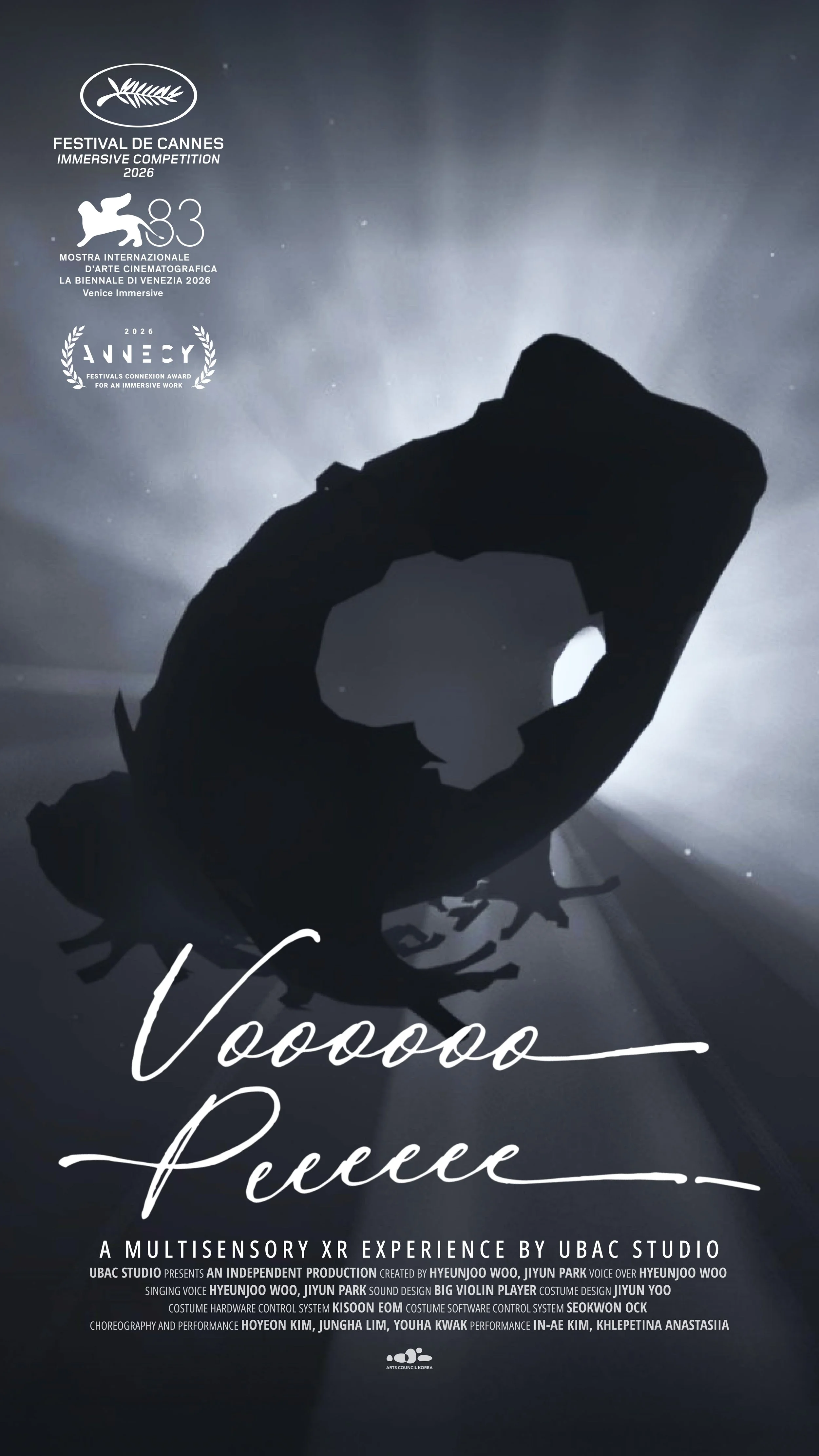
(01)
부우우—피이이—
VOOO000
PEEEEEE
A hollow scan.
A suit that breathes.
A sea of data with
no one in it.
Hyeunjoo Woo and Jiyun Park battle the scorching Annecy sun. It's their first time visiting the city and attending the festival. An intense week of setting up and acting as facilitators at the Salle de Création in Bonlieu, making sure audiences got the best of their exhibited piece. The pair first met at Kookmin University in Seoul, South Korea, where they both studied Entertainment Design.
Their research and student work focused on interactive media and expanded cinema. Today, they collaborate as Ubac Studio, a Seoul-based duo that creates and produces interactive XR installations exploring what technological systems overlook. Voooooo Peeeeee grew out of their shared fascination with creating interactive, immersive works.
This project tells a story about the void our fusion with technology can create without us realising it/ Close-up of the bespoke air suit, made from white, translucent material.

Their work explores the contrast between growing technological worlds and
how the human body actually experiences things. Their narrative grew from that tension, and as they developed the project,
they found its key
elements. They started
with underwater data
centres and digital twins.
"ALL THE DATA GOES UNDER THE SEA, BUT THERE ARE NO HUMANS THERE, AND YOU CAN'T HEAR ANYTHING IN
THE OCEAN, RIGHT? BUT IT LITERALLY TAKES PLACE IN
THE PHYSICAL WORLD, BEYOND
THE VIRTUAL."

/ Several copies of Hyeunjoo Woo's grandmother dance around you in Voooooo Peeeeee.
(CT scan)
Next came Hyeunjoo's grandmother's CT scan, which showed what seemed to be a large empty space. They decided to play with these oppositions and gaps: empty yet filled, absent yet felt, embraced yet feared. "We were fascinated by emptiness and the elimination of technology — the idea that there must be an empty space in the data, in the technological system. That's our interest: what the technology cannot see, or misses. And it overlapped with her grandmother's story — an empty, hollow image," says Jiyun.
“WE WANTED TO SEE THROUGH THE HOLE”
Woo and Park like to invent their own ways of using technology, shaping new interactions through unconventional approaches."We wanted to see through the hole — there's nothing there, but you can see something in it — and that's how we came up with these interactions." At first, the idea was simply to use the hands as an interface, but what really interested them was interaction: not just watching, but moving through it with the body. In the end, they settled on a hole formed by the hands. "Every interaction is different because people have different hand shapes and gestures. Some people make a perfect triangle shape, some a circle."
Design deeply informs their approach. Drawing on years of thought about UX and UI, Woo and Park combine artistic and compositional choices so the work conveys the right feeling. They test extensively before showing a piece, paying close attention to "how [the audience] experiences the work and how they'll get into it, including the path they take when entering the exhibition space." They typically spend three to four months on research. "After [that], we can see the big picture — the connections between the data centres, human digital twins, and her grandmother". They begin by developing the narrative before selecting the appropriate materials and media. During this process, they often find themselves saying, "We need to create this," because nothing similar exists in the current market. This was particularly true for the haptic system they designed
for the project.
The duo weaves metaphors into the project's material and narrative design. "We wanted to add some physical feedback. The main theme of our project is about virtual volume — we wanted to translate virtual into real." Working with fashion designers and engineers, they created a custom air suit. Its organic shape and white, translucent material give the suit a clinical, futuristic feel, heightened by the medical-cart rig and glowing tubing it connects to.
The project is deeply personal: Woo and Park appear in several layers, through their singing voices, their choreography, and Woo's grandmother's dancing image. Even the other characters are built from their own body movements. "Everything in the project is made from ourselves." They stress that they always use the medium themselves, because only then can they reach a truly personal interpretation. "We like to see the differences between the 'real us' and the 'data us.'" In motion capture, the physical dancers and their digital twins perform the same movements, yet differences still emerge. "I like to look for and find those differences," adds Hyeunjoo.
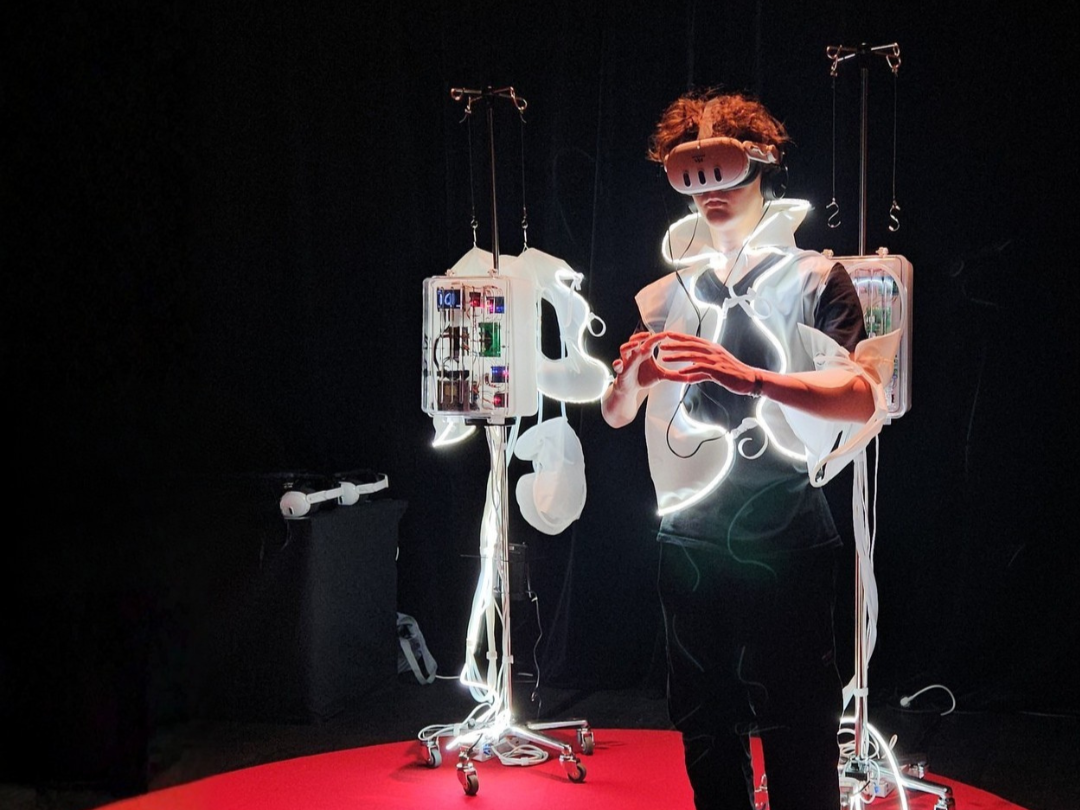
/ Voooooo Peeeeee at the Salle de création, Bonlieu, during the Annecy Festival.
Asked which XR works had resonated with them, the duo named Afterimage for Tomorrow by director Singing Chen, which they saw at the Bucheon International Film Festival in 2019. The film inspired them because, despite being Chen’s first venture into VR filmmaking, she already demonstrated a strong ability to direct the audience’s focus. It also engaged viewers through themes and techniques that resonated with Woo and Park, exploring memory and perception through VR while blending contemporary dance, spatial storytelling, and the persistence of vision.
Voooooo Peeeeee debuted at a solo exhibition by Ubac Studio and has since been selected for seven international festivals and exhibitions. These include Venice Immersive, Cannes, Bucheon International Fantastic Film Festival, Mediamorfosis in Chile, the Digital Cultures Festival in Warsaw, the group exhibition "Bridge of Light" at KF Gallery in Seoul, and the Annecy International Animation Film Festival, where it received the Festivals Connexion Award for an Immersive Work.
The official synopsis describes Voooooo Peeeeee as a multisensory XR experience that takes the audience into "a space where bodily presence and technological space overwrite one another." Lulled by the rhythm of breathing, viewers navigate a monologue that "drifts between memories of loss, data clouds beneath the sea, and endlessly replicated virtual worlds."
They are in talks with curators and distributors and want to ensure their work reaches not only festivals but also museums and cinemas. To facilitate this, the creators are adapting the work to different formats. "We have three versions: a VR version featuring the air suit, an installation version, and a performance version." The solo exhibition was presented as a performance, where the air suit, dancers, and real-time facial animation combined to create an engaging experience.

This work allows you to experience what technology cannot perceive. It offers an uncanny, humorous perspective on our codependency on technology and how it consumes us. This experience, through the very medium of technology, prompts us to reflect on our dependence on it.
/ Voooooo Peeeeee. Ubac Studio (Hyeunjoo Woo and Jiyun Park), Korea, 2026. VR: 20 min.