

Cardboard rooms.
Flooded lives.
Tactile Memories.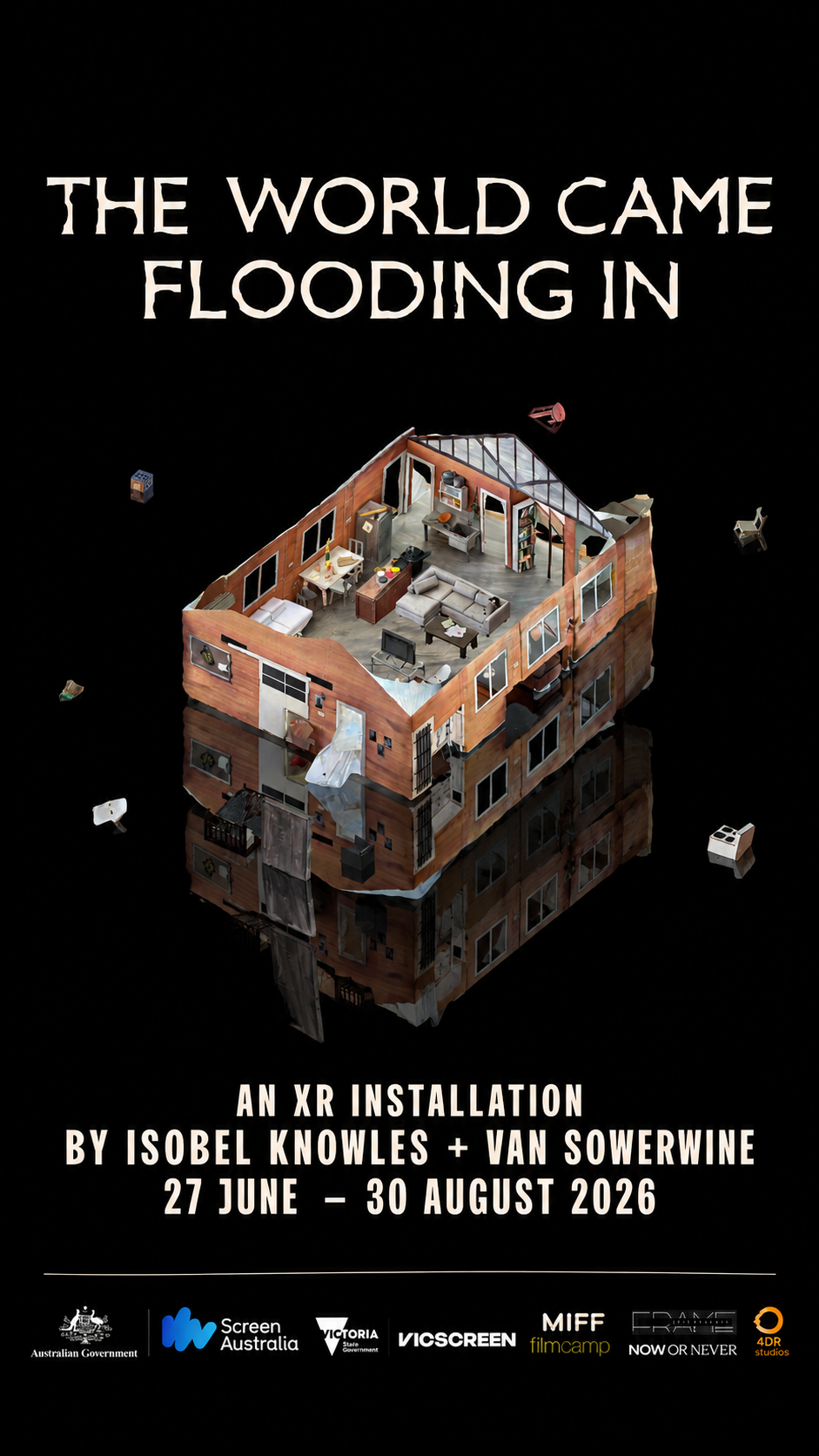
(02)
THE WORLD CAME
FLOODING IN
This interview has been edited for length and clarity.
It’s noon for me when Isobel’s video tab opens. For her and Van, it’s 9pm. Graciously, they agreed to this time slot — my first interview. I’m slightly apprehensive, but quickly get swept up in the pair’s journey into XR. They are the perfect example of the kind of artists I want to feature in this magazine: coming from a different field, passionate about XR’s potential. They approach the medium as something to explore and stretch to fit their style, which in turn will push their pieces in new directions. VR’s capacity to take us into the worlds they create clearly fascinates them.
Isobel Knowles and Van Sowerwine met in 2001 at art school. Since then, their love for stop-motion has been translated into different canvases. From traditional short films to installations and interactive pieces, the duo has been shaping stories out of memory and touch using handmade objects.
THE COMMON THREAD THROUGH ALL THEIR WORK IS HOW THEY AIM TO ENGAGE VIEWERS PHYSICALLY AND EMOTIONALLY WITH NARRATIVE-BASED STOP-MOTION EXPERIENCES.Could you tell us about your path into XR?
/ ISABEL KNOWLES / We made our first VR film, Passenger, in 2018. It was entirely stop-motion. We come from this background and are interested in creating a textural world on screen. This technique has a particular appeal: it brings inanimate objects in the real world to life.
For The World Came Flooding In, we wanted something more interactive than another 360° film. I was introduced to photogrammetry while working on another project, and we realised we could use it to bring our stop-motion aesthetic into a digital world. We scan objects at a much smaller scale than the medium is designed for, creating imperfections that connect with the work’s themes of memory.
How did you first encounter XR?
/ VAN SOWERWINE / We saw a VR artwork by New Zealand artist Jess Johnson at the National Gallery of Victoria, around 2016 or 2017. We’d never seen anything like it: beautiful drawings you could move through. The feeling of immersion really spoke to us. We’d already made installations that invited people into animated worlds, and VR offered another way to tell stories
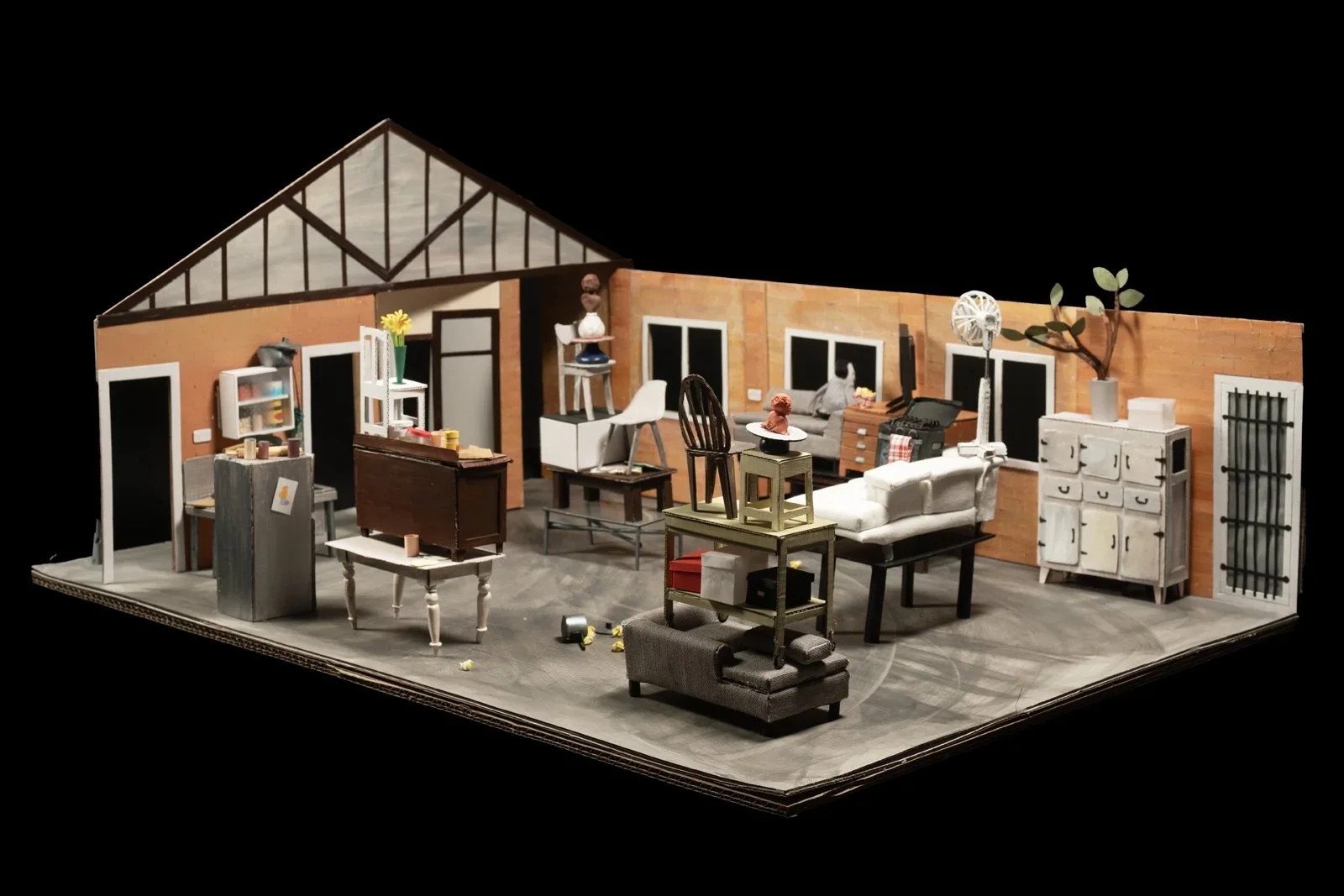
/ Recreation of artist Antoinette O’Brien’s house in Lismore in The Water Came Flooding In.
Is it difficult to describe your immersive work to people outside the field?
/VS/ Much more difficult than describing a film. Many people haven’t experienced VR or realised how many forms it can take, so they lack a frame of reference. Our work is particularly hard to explain because it uses scans of handmade miniature cardboard rooms and furniture.
We’re developing a projection version for regional galleries that may only have the resources to offer VR for an hour or two a day. We wondered whether showing it in this format would give too much away, but being inside the spaces and moving around them are very different experiences.
/IK/ When we recreated rooms from our own childhoods as an early experiment, scanning them and putting our heads inside was like a punch in the gut. I hadn’t been in that room since I was eight. Suddenly, I was back there. Even when visitors aren’t exploring their own memories, knowing that the narrator actually lived in the space makes a difference.
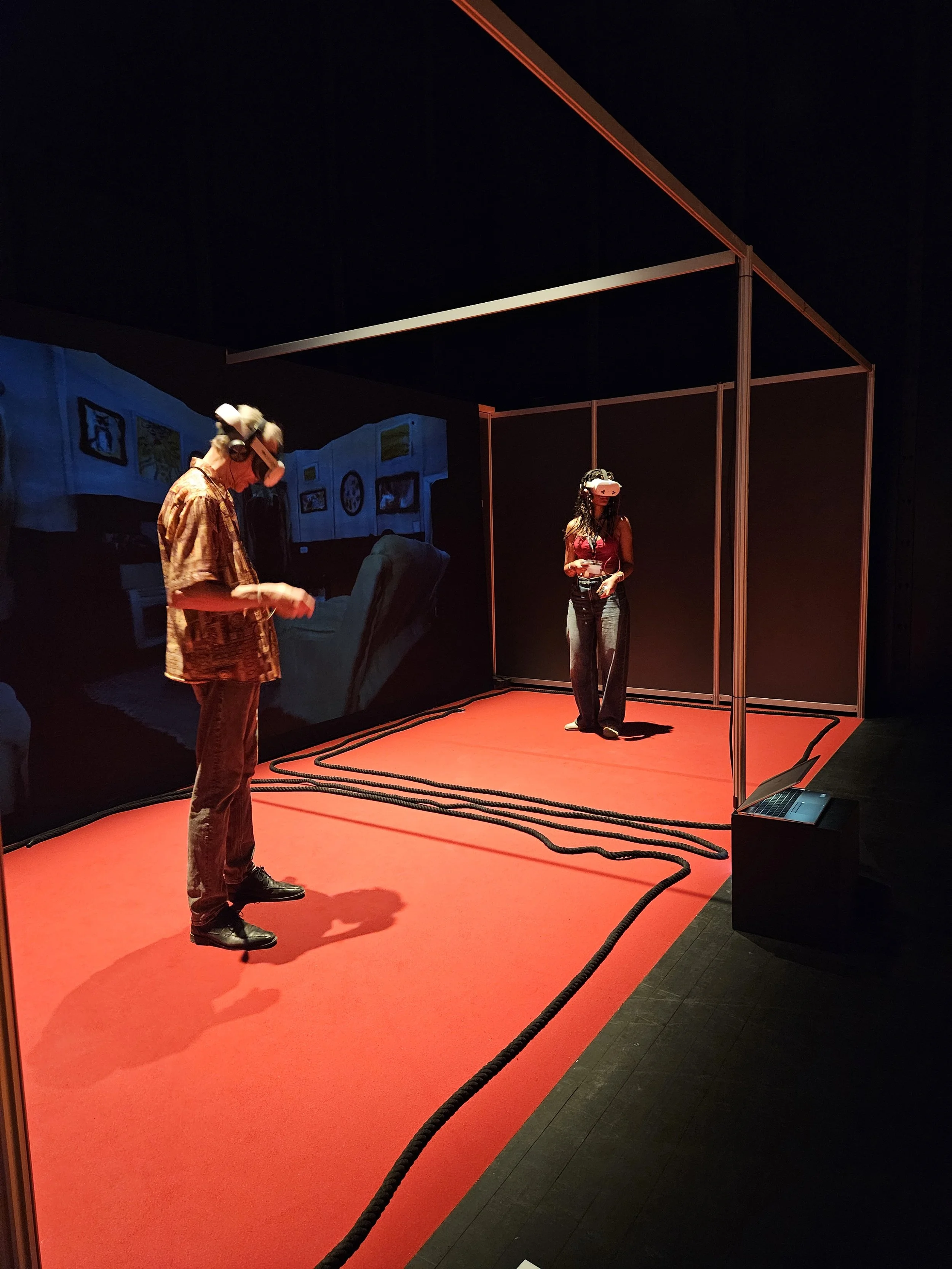
/The World Came Flooding In at the Salle de création, Bonlieu, during the Annecy Festival.
In The World Came Flooding In, you worked with three people to bring their memories to life. How did you approach that process?
We travelled around Australia, spending time with each person and getting to know their stories. VR narratives need to be concise, so we chose scripted narration rather than edited interviews. The scripts are built from the storytellers’ actual words, giving the work structure while retaining their voices.
We developed close relationships with the storytellers and workshop participants, gathering photographs and descriptions of their former homes, building miniature versions and recording their reactions. We also worked with a trauma-informed consultant to make the process collaborative rather than extractive, with ongoing consent and care for how people’s stories would be used.
“The subject is difficult, but the experience can also be enriching.”
How do you honour memories of traumatic events without the work becoming exploitative or too painful?
We took small steps and made sure people genuinely wanted to participate. We initially ran workshops with flood-affected communities, following advice that making something side by side can give people space to share stories without being put on the spot.
Our Memory Postcard workshops invited people to recreate furniture they’d lost in a flood or another disaster. We worried the process might upset people, but the workshops were incredibly positive. Recreating something you’ve lost can feel almost like getting it back: you give a memory a physical form. The subject is difficult, but the experience can also be enriching.
One of the storytellers, an artist in Lismore, is exhibiting her work alongside the project this November. The other two have also championed it.
What choices did you make to protect the audience’s experience?
/VS/ We wanted people to feel cared for, not confronted with difficult material without warning. Our narrator speaks calmly to the audience, and we tested the language and helped people learn how to use VR. In one scene, when a house floods, visitors can choose to skip it.
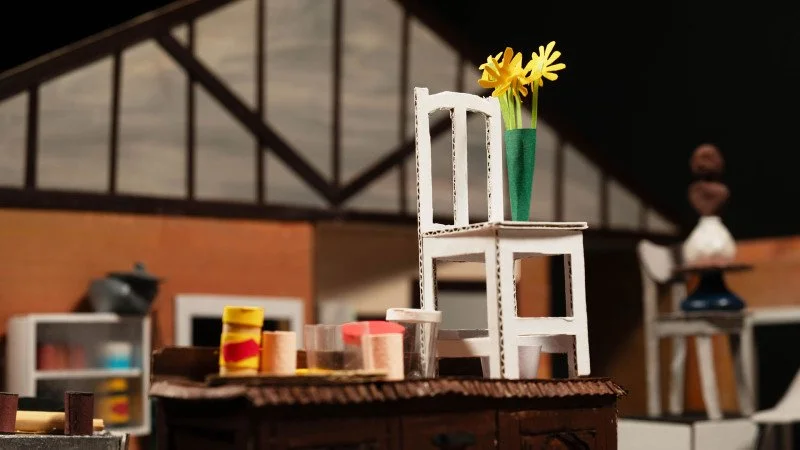
/ Detail of Antoinette O’Brien’s house: furniture stacked on a table ahead of the flood in The Water Came Flooding In.
Has distribution been different from your previous work?
/VS/ Passenger was a 360° film distributed by Diversion Cinema, which brought it to different venues. This project is more demanding because it’s an interactive installation, and we often have to set it up ourselves. The exhibition format can be more rewarding for audiences, but it costs time and money. Alongside the VR, we show miniature rooms, photographs from workshops with flood-affected communities, and even some augmented reality elements. We’re also experimenting with projection so people can access the story when headsets aren’t available.
/IK/ There’s a tension between gallery visitors and experienced festival-goers. At an XR festival, some people wanted us to get to the point faster. But for newcomers, guidance matters. We didn’t want people to feel silly or frustrated while also dealing with difficult stories.
We built in prompts and automatic transitions, with a maximum duration. Too much freedom can distract from the narrative, so we were willing to sacrifice some interactivity to protect the story.
How do you decide which interactions to include?
/IK/ Most are optional. People can explore objects or simply stand still and listen. We tested the work extensively and found that some people struggled with teleportation, so we developed a “cinema version” in which visitors look around while moving automatically between scenes. The interactive adaptation makes you an active participant; the cinema one is more relaxing. Both have their strengths.
The objects also connect to the storytellers’ lives. We scanned a writer’s book, records damaged in a flood, family photographs and a passport, as well as surviving ceramic artworks. You can pick them up and explore them.
We need more ways for people to experience VR beyond festivals and galleries. There are emerging venues for group viewing, including a VR cinema at Perth Museum, and cinema-foyer programmes showing VR shorts. Our “cinema version” may help us reach those audiences.
What’s your relationship with the technical side of building these experiences?
/VS/ We’re committed to understanding and playing with the tools ourselves, even though we also work with developers, composers, and other creative people. It’s tiring, but rewarding. Artists who have to pay production houses can face a real barrier; if you can experiment with technology yourself, you can begin to discover what’s possible.
/IK/ We’ve been lucky to work with independent developers. Our current developer enjoys being challenged: we keep changing things, and sometimes we break what he’s built. He’ll make us a tool; we’ll experiment with it for weeks, and he’ll say, “That’s not what it was built for.” But that’s how we’ve made this project.
“Coming from different creative fields helps us question what technology is supposed to do. We try things, tinker, and discover new possibilities for storytelling.”
/Van Sowerwine
The World Came Flooding In premiered in August 2025 at ACMI in Narrm (Melbourne), before making its international premiere in Rotterdam in January 2026. Since then, it has received several awards, including Best International Project: Immersive Impact at Doc Edge, Best Interactive/Immersive Documentary at the 2026 AIDC Awards, and the Lumine Award for Best Virtual Reality Work at Tricky Women/Tricky Realities.
Its international tour has taken it from Australia to Vienna, Paris, Berlin, Annecy, Auckland, Galway, London, Kaohsiung, and Jakarta, with further presentations in Leipzig as part of DOK Leipzig and Prague for Art*VR.
When you enter this experience, there’s almost a sense of voyeurism: you’re listening to people’s own voices about their own stories, while standing inside their houses. It’s a true privilege to step into their inner circle and learn what gives their objects such sentimental value.

By the end of the call, we are happy to realise that we see eye to eye on a lot of things, including XR’s power to carry us into imaginary worlds, and the fresh ideas professionals from different fields bring to push its boundaries. I’m looking forward to seeing where Isobel and Van take it next.
/ The World Came Flooding In. Isobel Knowles & Van Sowerwine, Australia, 2025. VR: 25 min