

A PAPER WORLD.
A CHILD’S GUILT.
UNFAIR POWER DYNAMICS.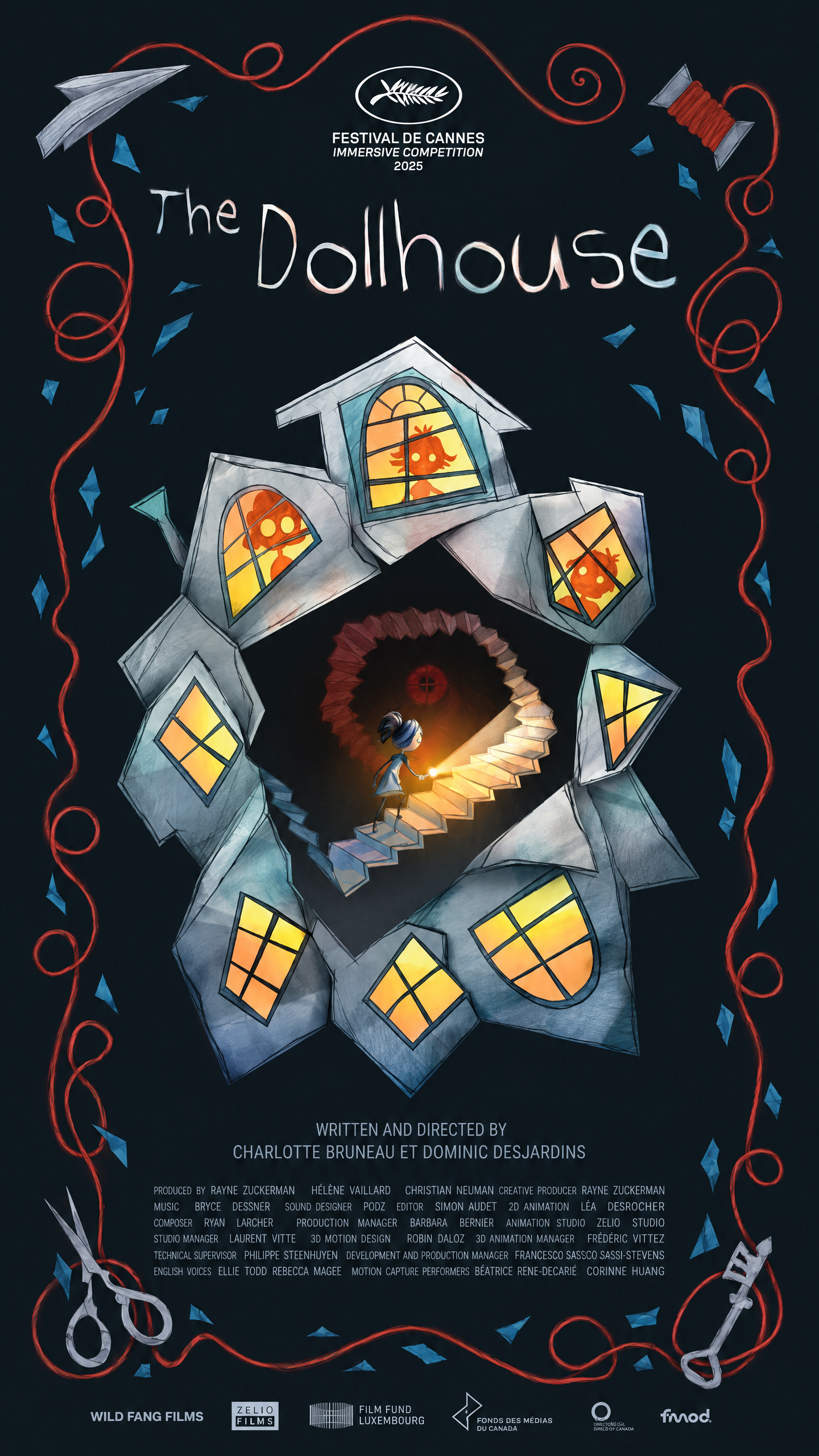
(05)
THE
DOLLHOUSE
I came into contact with The Dollhouse in 2025, when it crossed my jury list on the European XR Awards, in the Best Animation category — which it ended up winning. I was happy to finally meet one of its co-creators. Writer and director Dominic Desjardins’ enthusiastic view of VR as a “promise of the new cinema [...] something we’ve dreamed of for so long. And now we’re just on the cusp of it” comes through in how he shares details about creating The Dollhouse.
As executive producer and head of the Canadian Francophonie Studio at the National Film Board of Canada (NFB) for five years, Desjardins produced the first VR 360° documentary at the NFB, The Third Wheel, released in 2015. Back at Zazie Films, which he founded with his partner Rayne Zukerman, Charlotte Bruneau, a Reuters journalist he had met at one of the NFB’s workshops introducing traditional storytellers and documentarians to VR, approached him. He was immediately won over by how her project approached human rights: not in a war-torn country, but “in the heart of the family and so in the heart of the home.” Desjardins moved from producer to co-writer and co-director, and together they chose VR for its “potential to create empathy.”
vr as a “PROMISE OF THE NEW CINEMA [...] SOMETHING WE’VE DREAMED OF FOR SO LONG. AND NOW WE’RE JUST ON THE CUSP OF IT”/ The miniature coming to life.
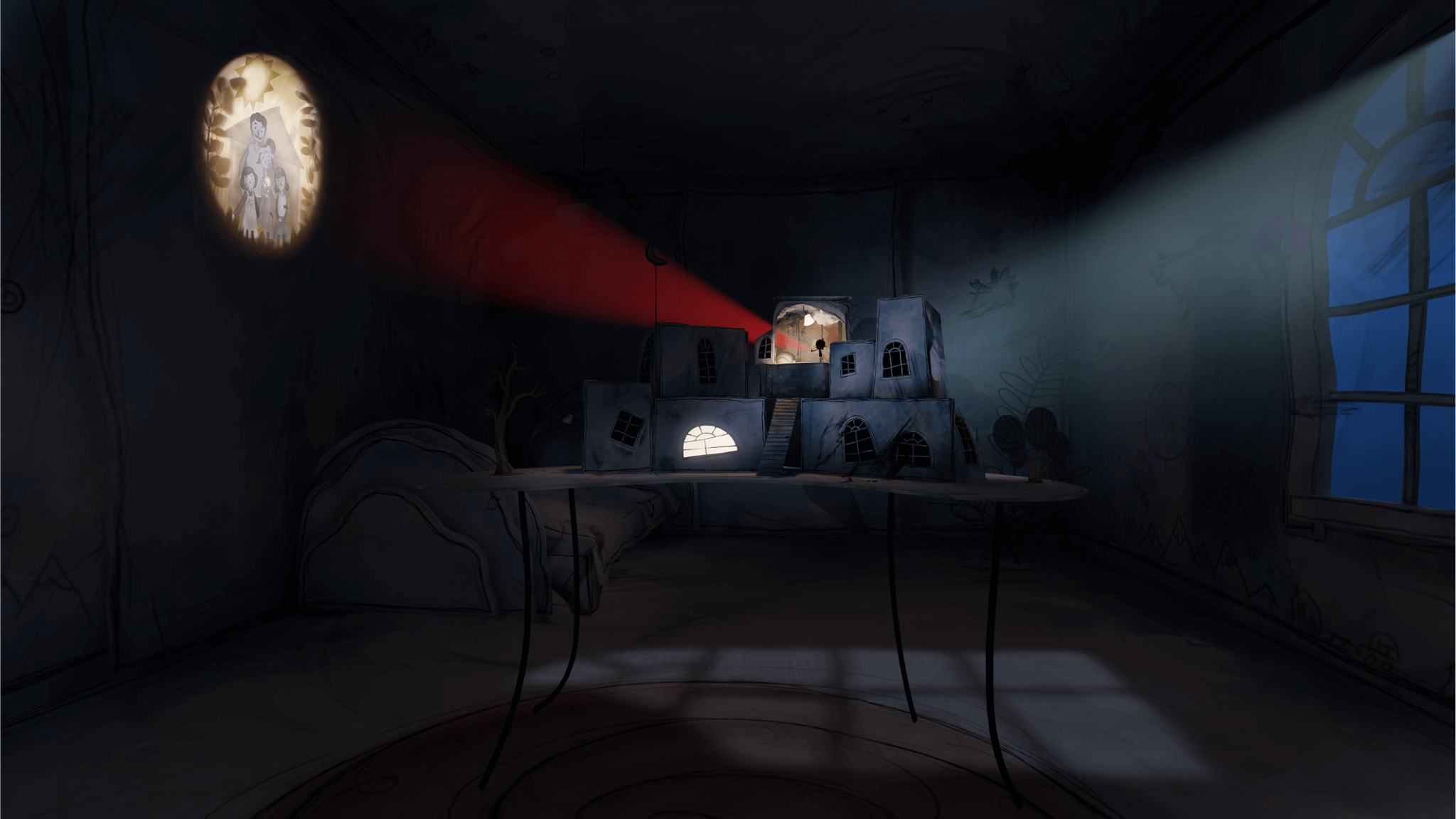
The pair created a world where you have agency to move around and decide what to watch, but the story will keep moving without your input — an approach that brings you “to another level of comprehension and appreciation for the piece without derailing it narratively or introducing lots of branching possibilities.”
That vision became The Dollhouse, produced by Zazie Films and Wild Fang Films. It is a linear narrative told through a paper diorama animation, in which 9-year-old Juniper uses her dolls to relive memories of Magnolia, the domestic worker her family employed, revealing themes of guilt, class, and growth.
“THERE’S SOMETHING FASCINATING ABOUT SEEING A LITTLE PUPPET THEATRE COMING ALIVE IN FRONT OF YOU”
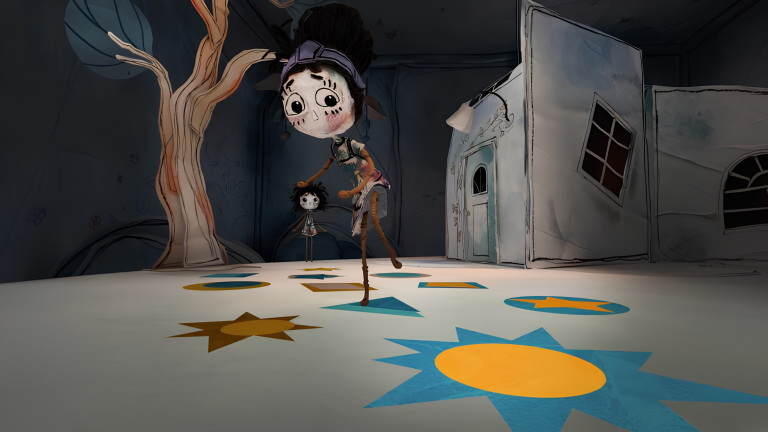
/ Magnolia playing hopscotch.
(Layers of Depth)
The audience’s interactions have an impact not on how the story unfolds, but on how much of it you get. Desjardins gives an example: “You have the two cups, one that you hold to your ear and one that you hold to the house. If you don’t do it, you won’t hear what’s happening in that chapter inside the house. You’ll get the general idea, but you won’t access that second level of the story.”
“THAT SLIPPERY SLOPE OF THE POWER DYNAMICS”
THE PIECE EXPOSES THE FRAGILITY OF DOMESTIC WORKERS, THROUGH THE INNOCENT EYES OF CHILDREN.Desjardins and Bruneau wanted to make the user feel they are “participating in that slippery slope of the power dynamics that [end up] creating this situation of human rights abuse.” By building gameplay around children’s games, they felt players would connect with the story more instinctively: “you’re performing the actions, you’re accompanying what’s happening, and you get a sort of understanding that’s physical.”
Bruneau brought the angle of capturing the fragility of domestic workers and households through the innocent POV of the children: they don’t know what is happening — they see a new friend, maybe even a second mother. Desjardins explains: “That person has a function inside the household. But if you reduce that person to that function, essentially you’re taking away her humanity and abusing that power dynamic.”
When deciding the visual style, they chose a paper aesthetic for its link to the fragility of the subject. Rather than aiming for hyper-realism, they put their time and energy into making the paper’s texture and sound convincing: “there aren’t many materials, but you believe them.” Next came the movement of the characters.
“We created a puppet, put all the sensors on it, and had them [the puppeteer] manipulate it. It failed miserably.” They quickly realised that you need to see the puppeteer actually bringing the puppet to life. “If you take only the data — the movement — you’re left with only an awkwardly moving form. But that’s what VR is about. Fail fast. Try things and do it in a circular way where you’re iterating and you’re seeing what works and what doesn’t.” They then opted for motion capture and sent the recordings to Zeilt, a studio in Luxembourg, which created facial animations and adjusted the movements so the characters didn’t look too human.
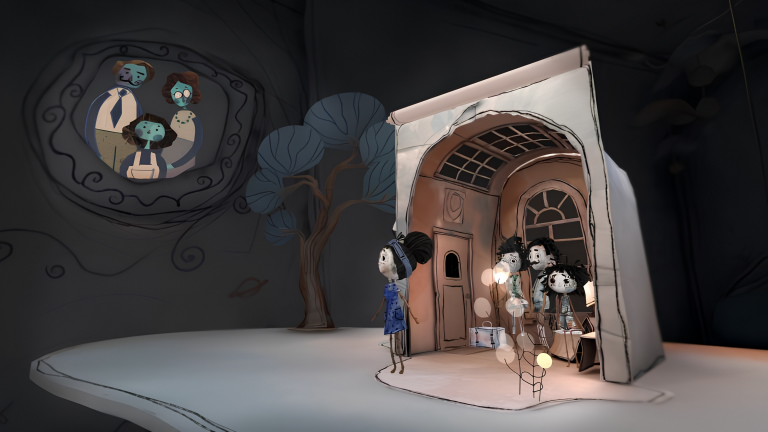
/ Magnolia missing her family.
Looking ahead, Desjardins sees humour as an opening: “I think that comedy is a great way to have people open up and be involved in the story and then get hit by the emotion.” He would love a VR piece with the tone of Fleabag, for example. The Dollhouse also taught him the value of metaphor: “having a metaphor stylistically is fantastic. That level of metaphor brings you into the story a lot faster.” The next projects will keep a visual representation that is “not trying to be realistic,” with more humour but without losing social relevance.
Although the project has been invited to more than 20 festivals around the world, Desjardins still feels the lack of distribution paths for VR works. “Narrative pieces don’t get a lot of visibility in the stores. And so what happens is that they meet their audience on the festival circuit.” Museums, he believes, offer a way out: they already have steady footfall, and visitors may treat a headset as a special stop, like trying a ride at an amusement park.
Asked about recent works that stayed with him, Desjardins names two. A Long Goodbye paints fragments of an environment rather than showing it whole, in a poetic journey where “things appear and disappear in ways that really make the best of this medium, which is all about transitions.” Clouds Are 2000 Meters Up shares that fragmented feel but lets viewers walk around with live actors as they perform. Though technically very demanding, it is also very promising, and he expects technology to move towards more experiences where “we are in the movie.”
With the Canadian Embassy and the Korea Foundation, the team showed The Dollhouse in Facing Faces, a rights-focused exhibition at the KF XR Gallery in Seoul that ran from March to July 2026. Visitors arrived at a painted booth that made them feel they had entered the work’s universe before putting on the headset. “I really believe that’s the formula. I hope more galleries will also decide to put on VR works not just paintings or sculptures,” says Desjardins.

The Dollhouse takes a delicate subject and tells it through a child’s eyes, which makes it all the more powerful. That its creators are so passionate about the possibilities of the medium is a good omen: this will certainly not be the last time they move us.
/ The Dollhouse. Charlotte Bruneau and Dominic Desjardins, Canada and Luxembourg, 2025. VR: 25 min.