

(04)
LESBIAN
SIMULATOR
Color explosion. Shooting love.
“I am gay!”
The computer froze four times. The volunteer rebooted each section. The door was almost closing, but I managed to grab my lousy six carabiners in front of the cheering Pride crowd. Whispering "I am gay," or fiercely grabbing the hand of my virtual girlfriend as the people around us made nasty comments, were some of my experiences inside Lesbian Simulator on the last day of the XR exhibition in Annecy.
By the time I sat with digital artist and director Iris van der Meule, I still hadn't gotten my 40 minutes of colourful lesbian existence. Based in Amsterdam, Iris researches immersive storytelling and creates VR experiences and animation films that focus on socially relevant subjects, like discrimination against the LGBTQIA+ community, climate change, mental health, and gender inequality. She also brings this focus and care to her role as VR Curator at the Kaboom Animation Festival.
Lesbian Simulator lets you experience some of the hardship of being a lesbian./ The lesbian club scene.
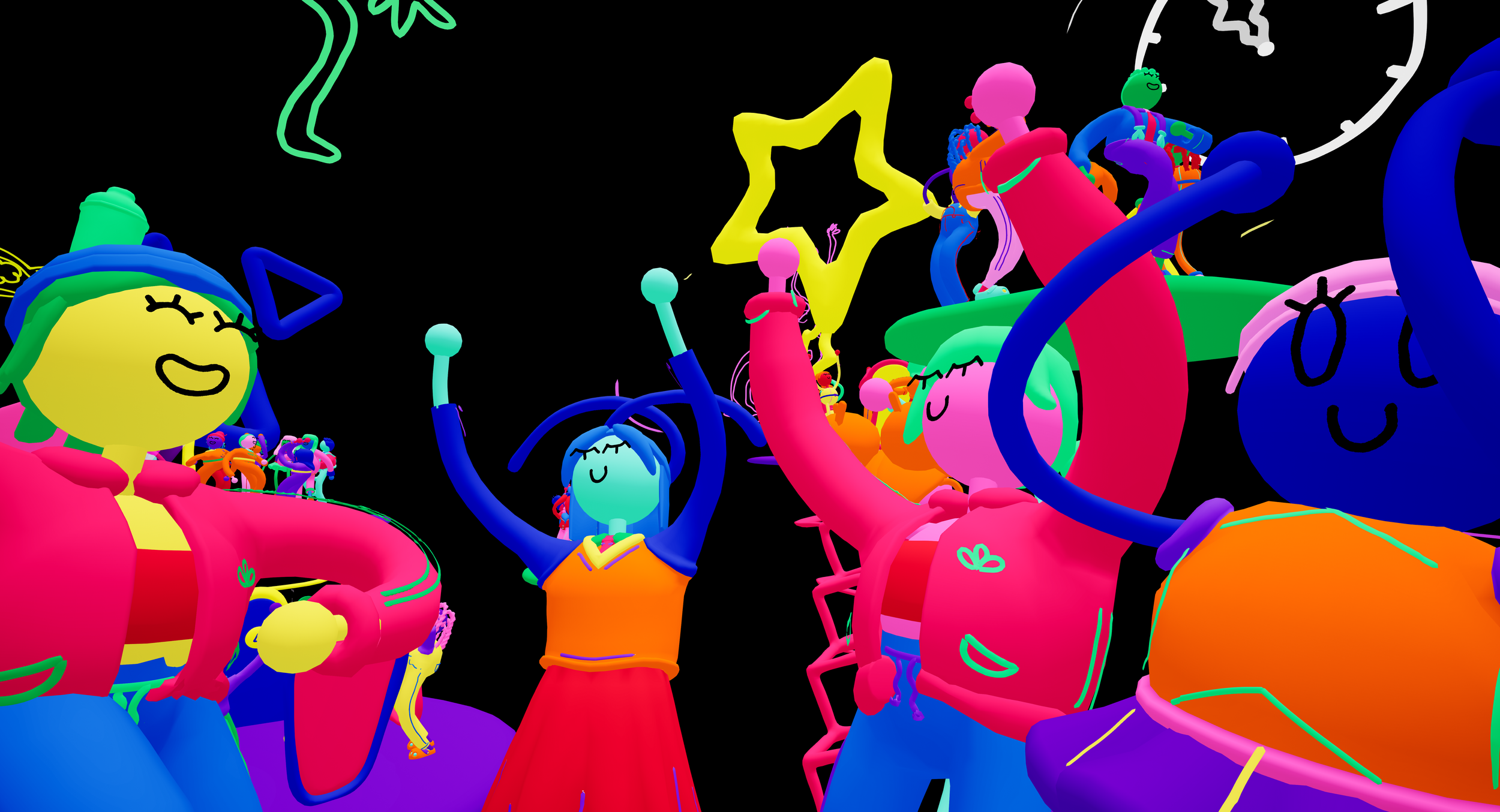
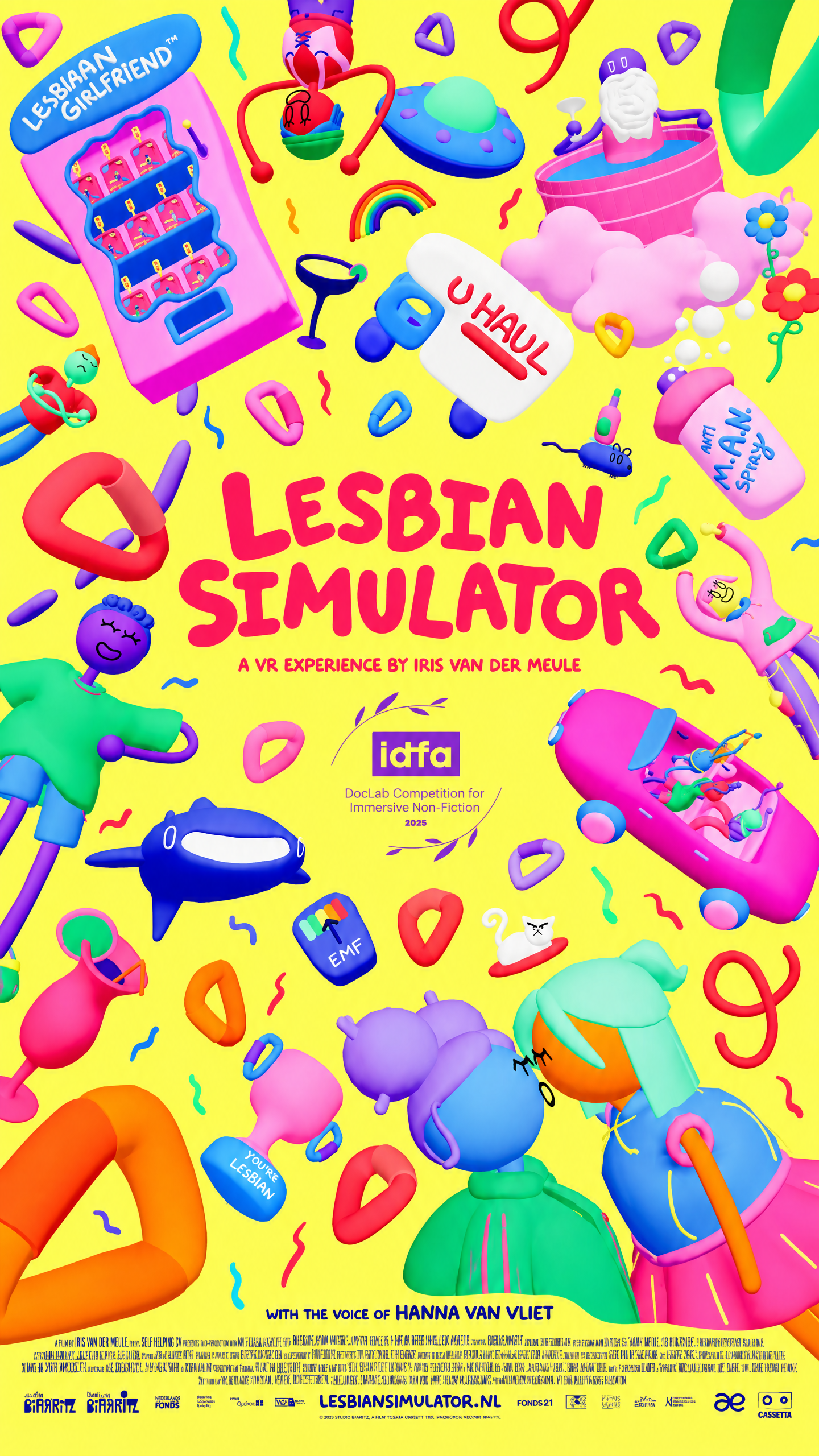
While joyful and colourful, with impeccable comedic flair in the dialogue, drawings, and sets, her latest project, Lesbian Simulator, lets you experience some of the hardship of being a lesbian.
“I'M A LESBIAN MYSELF, SO I REALLY THOUGHT ABOUT CERTAIN THEMES THAT WERE INTERESTING OR IMPORTANT FOR ME TO COMMUNICATE TO THE AUDIENCE. THOSE WERE BOTH ABOUT QUEER JOY, BUT ALSO ABOUT DISCRIMINATION AND HOMOPHOBIA”
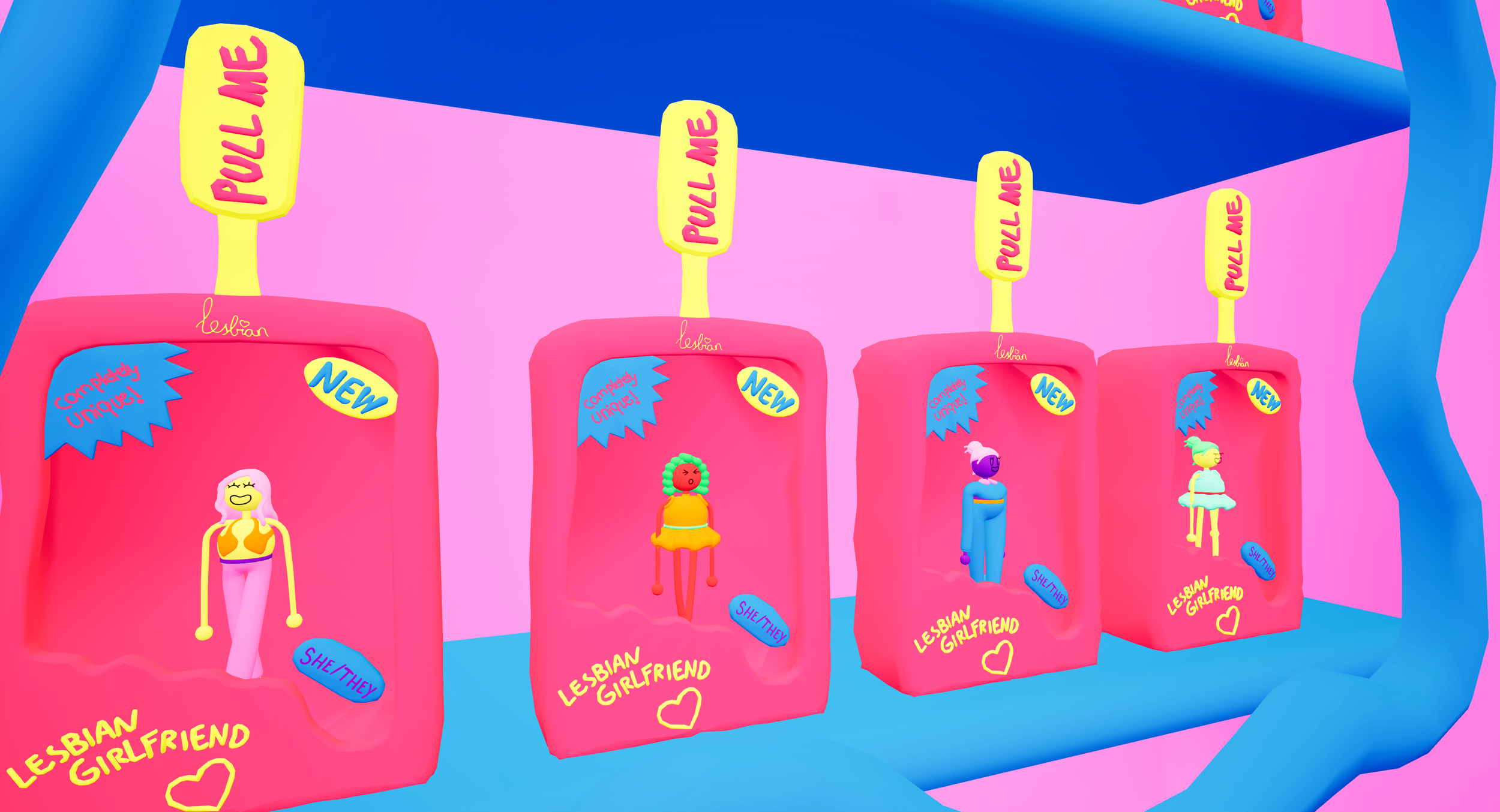
/ Time to pick a girlfriend.
(Queer Joy)
The project took approximately six years to make. With the concept defined, she kept experimenting with the VR world using the software Quill. That ability to sketch in 3D and understand how it worked spatially from the beginning was crucial to developing her idea about what it could look and feel like. What started as a quick drawing style turned out to be perfect for the piece: stick figures and strong colours. “After a couple of months I was like, ‘I actually like this style’, the simplicity of it.”
“AN IDEA OF THE WESTERN, DUTCH-FOCUSED QUEER COMMUNITY”
In parallel, she did research and interviews to ensure her work was an accurate portrait of the journey of a Lesbian.Given the subject matter, Iris saw it as essential to test different prototypes of only one to two levels with a variety of audiences: “I felt like it was important to not only have my point of view, but also the point of view of other queer people, and of straight people, because in a way, the work is actually for them, to teach them what happens to queer people on the streets.”
Built to be experienced as a game, Lesbian Simulator has eight levels, each with its own mini-game about a different aspect of the coming-out journey. Its quick pace and engaging gameplay keep players entertained and eager to reach the next one without noticing that 40 minutes have passed. In each level, based on how you perform, you earn carabiners that add up at the end to reveal your ‘Lesbian Rank’. For each level, Iris thought about what interaction she could attach to each one that could help her translate a certain queer experience. From successfully offering drinks to surviving a first date and a tense metro ride, one of the most iconic mini-games is the one where you have to actually come out and say, ‘I am gay’. “I can never really simulate how it really is to come out because there's no consequence in VR. But I can play with the fact that people in a VR headset already feel a bit awkward in the exhibition room, and then they have to speak, and it makes them feel a bit like, ‘Oh, should I do it?’"
Unlike her previous graduation works, this time around, Iris had a linear narrative, with a lot of dialogue, something she had always avoided before. Balancing moments of physical activity with moments of simply listening was an exciting challenge for the creator, and she tried to borrow game design techniques to make it work. “For example, there's a sort of shooter game at some point where you have to shoot, love, like hearts, at people. There's also a level that's more based on horror mechanics to make you feel a bit scared. So you have to close the doors of a subway real quick to not let monsters in and spray them away.”
As for the team, Iris was introduced to her Dutch producer, Corine Meijers from Studio Biarritz, at the talent hub in the Netherlands, where she started the project. Together, they applied for funding and went to pitch markets, which helped them find co-producers. After the festival circuit, they are thinking of impact production; they want the piece to reach broader audiences and positively influence queer rights. They want to place it in schools, libraries, and ultimately put it online so people with a headset can play it too.

/ A romantic dinner with a side of stressful comments.
When thinking back to works that stayed with her, Iris is struck by how much influence those works had on her debut piece. She names two: Jenny van den Broeke’s (Studio APVIS) poetic Ver binnen, with its great use of immersive space and Daniel Cannizzaro and Samantha Gorman’s (Tender Claws) high-paced interactive story Virtual Virtual Reality. Looking ahead, she pictures herself exploring dynamic characters and the autism experience for women.
Coming from traditional animation, the director sees the change in canvas size between that and VR as the biggest but also the most fun challenge. “I have to scatter the narrative around you, and you will pick up probably 90 percent of it." You have to embrace the 360º: “there are sometimes moments you need to focus [the audience’s] attention. But still, if they look at somewhere else, they should still understand your story somehow." That’s why editing in VR looks more like 3D world-building.

About a decade after first finding VR at art school, Iris confidently says to any artist curious about making the leap into XR: “I feel like everyone could do it. I'd say to people: don't be scared to try it out, because there's still a lot to discover.”
/ Lesbian Simulator. Iris van der Meule, Netherlands, 2026. VR: 40 min.